A public obsession: Bringing Aboriginal art to the people
It’s a long way from politics, but by sharing his collection of contemporary Aboriginal art with everyone, former politician now fulltime artist David Hinchliffe remains committed to educating the broader community.
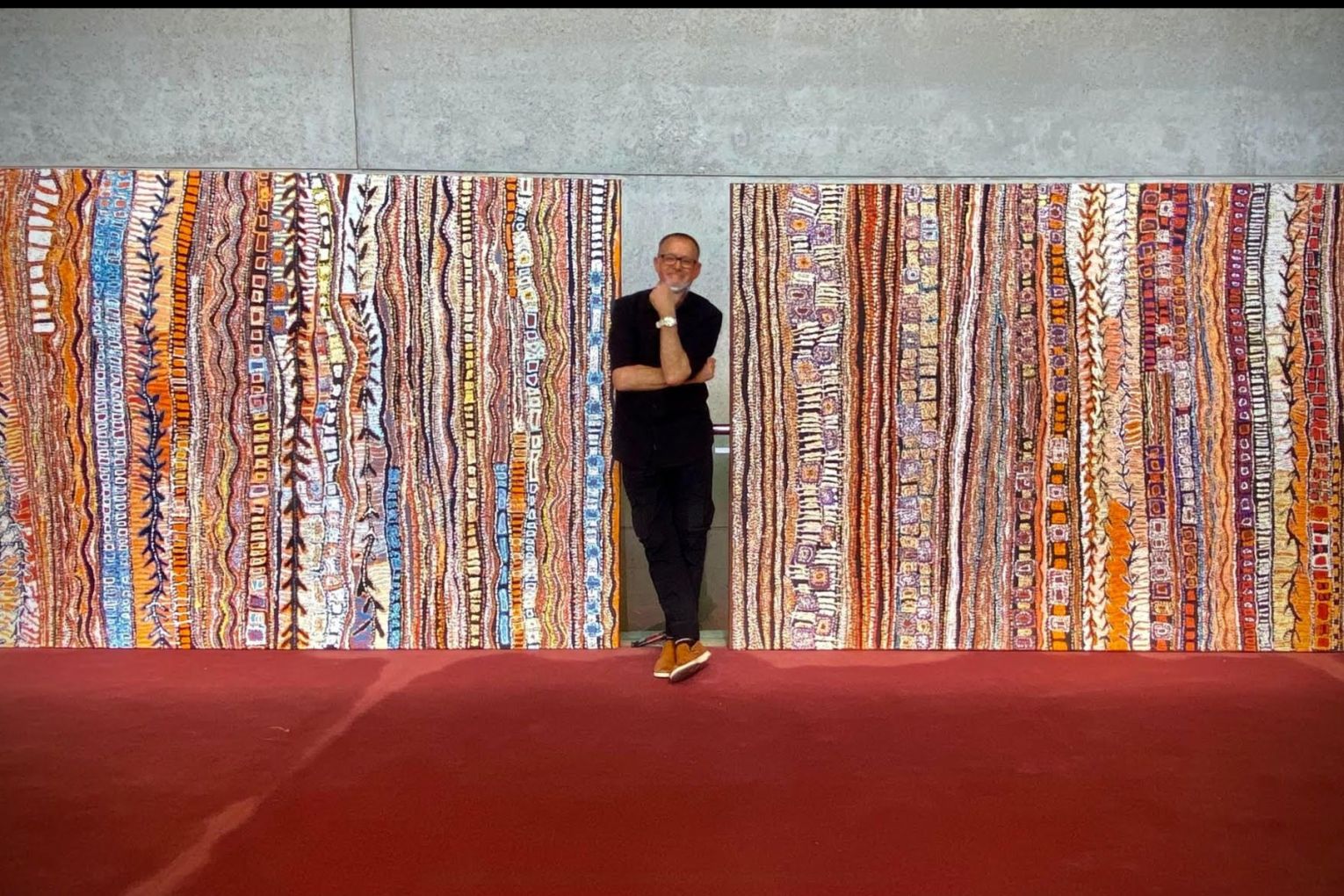
David Hinchliffe is best known to most Queenslanders as a politician who, for more than 20 years until 2011, was a Labor councillor at Brisbane City Council, including four years as deputy mayor.
Perhaps not known to everyone is that long before he was a politician Hinchliffe was an artist – painting evocative cityscapes, often explorations of international cities such as New York, London, Paris.
In recent years, this practicing artist’s obsession has focussed on Aboriginal art. Equally compelling is Hinchliffe’s wish to share a growing collection of contemporary Indigenous paintings with the broader community.
Hinchliffe’s own artwork he describes as “pleasant, commercial and popular”. He has exhibitions all over the world, also teaching painting workshops and mentoring students.
“I don’t consider my work to be great art, but it makes people happy,” he says modestly. “They like having it up in their office or their home.
“Once I had aspirations. I had some critical success very early on, in my teenage years. As a young adult, James Gleeson mentored me. I went through all the angst, in the 1970s and 1980s, to do good work. John Rigby and William Robinson taught me.
“Robinson told me, ‘David, painting comes easily, perhaps too easily, to you. I don’t think you’ll be doing really good work until you’ve suffered a bit’. Bill denies ever having said that, but it’s a strong memory for me.”
In April 2017, Hinchliffe was visiting a friend in Melbourne and saw, on the walls of his home, an Aboriginal painting. It was a revelation.
You might like


“It was so foreign to me. I don’t even remember the name of the artist. I hadn’t been exposed to central Australian art in all of its many forms, even as an artist for 40 years. I think I was like a lot of Australians who are on the periphery of understanding Aboriginal art.”
‘I love that contemporary Aboriginal art is modern and ancient at the same time’
What struck him in the painting he saw was its strong abstract qualities.
“I’ve always been attracted to abstraction, partly because I can’t do it myself as a visual artist. With Aboriginal art, too, there are stories being told. I had that Western impulse to understand the story. When I was told that not everything was going to be explained, I found it frustrating, and then even more attractive. It adds mystery to the story. I love that contemporary Aboriginal art is modern and ancient at the same time.”
Hinchliffe found, around this time too, that his painting career was taking off.
“I sell paintings for $5000 or $6000. My friend had bought his Aboriginal painting, a masterpiece, for around the same amount. From that point on, I had an equation in my head. I decided that whatever I sold of my own work, I would buy from Aboriginal artists. That’s pretty much how it’s worked out. I have been able to rationalise my own obsession with Aboriginal art.
“I pursued a career in politics for 25 years, and painted all the way through that. When I left politics I could pick up the brushes, and I had a style that resonated, and subjects that resonated. It made me happy. And it made others happy.
“I thought, happiness is much better than angst. To gain artistic recognition, I’d have to bleed onto the canvas, and release all that confected angst. But then, when I had this equation about the sale of my paintings being turned into Aboriginal paintings that I could acquire, I could be satisfied.”
His earliest acquisitions were dot paintings, quality work by some of the well-known names – Gloria Petyarre, Emily Kngwarreye, Minnie Pwerle, Rover Thomas.
“I never said or even thought, okay, I’m going to be a collector. It came upon me when suddenly I had 50 paintings. Then I thought, what the hell do I do with these?”
Subscribe for updates
Living in a small abode in Brisbane’s Spring Hill, Hinchliffe rapidly ran out of space. Art collectors often define themselves as people who buy more than they can hang, and he found himself building an airconditioned store then extending that to a rented storage space.
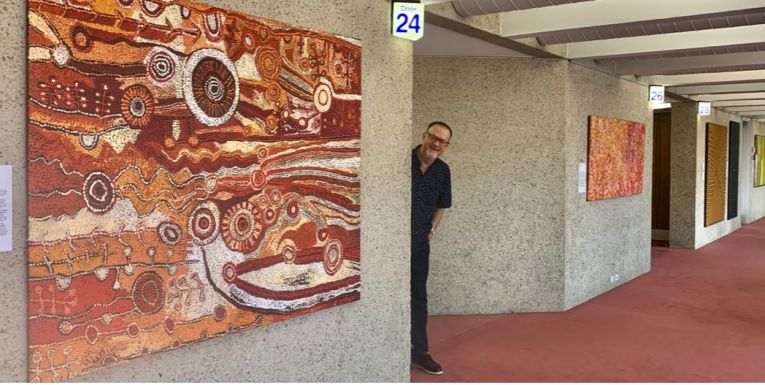
The next phase was working to get this artwork, in which he believes strongly, into the public arena. His exposure to art in public life meant that, from the outset, he steered away from public collecting institutions.
“What you see on the walls is a tiny percentage of their collection. It is an obscenity to have paintings under wraps that were painted as an expression of what is meaningful and powerful. Those paintings weren’t intended to be put into storage. My project is to elevate people’s understanding of Indigenous art, and the way to do it is to show it in its gobsmacking glory.”
Hinchliffe set out to loan work to public places where it could be seen, without any cost to the venues. Nonetheless, it has not proved easy, with layers of institutional approvals required. But in recent years his collection has been made available to venues including the QPAC, the Queensland Children’s Hospital, All Hallows School, University of Queensland health clinics and, increasingly, to refugee centres and community-run neighbourhood centres.
He continues to look for more venues to show these paintings – which include strong works by artists such as Zaachariaha Fielding, Simon Hogan, Nyurapayia Nampitjinpa (Mrs Bennett), Dorothy Napangardi, Karen Napaljarri Barnes, Jack Dale Mengenen, Kathleen Petyarre, and Prince of Wales (Midpul).
“All I ask is that any venue take a lot of them. I don’t want to give a venue one or two paintings. I want people to see this work and to get familiar with it.”
For Hinchliffe, it is important to have the work speak “to people for whom art is not a natural part of their lives”.
As his collection has grown, Hinchliffe has continued to visit more art centres, more galleries and become familiar with the politics of acquisition. He is passionate about respect for Indigenous artists, which prompted his public rebuke (in the pages of The Australian) to APY (Aṉangu Pitjantjatjara Yankunytjatjara) director Skye O’Meara over her refusal to resign over the “white hands on black art” scandal that played out in the pages of the newspaper. See Hinchliffe’s response to O’Meara at davidhinchliffe.com.au/articles.html
At this stage, Hinchliffe has about 1600 Aboriginal paintings, a collection that grows constantly. He continues to seek venues to display this life-affirming, colourful work. He’s all too aware of the crucial role of art sales for regional Aboriginal communities. For some, “art is their only industry”.
For the venues, too, the art brings joy, purpose and community to people. Politics at its altruistic heart is about serving the people. By sharing these Indigenous paintings, Hinchliffe offers the urban community an opportunity to engage with Australia’s oldest living culture in its contemporary and living vibrancy.
Paintings from the Hinchliffe Indigenous collection are located at the University of Southern Queensland (230), Bond University ( 70) , the University of Queensland (20), Queensland Children’s Hospital (80), QPAC (70), Fortitude Valley State Secondary College (70), All Hallows’ School (70), and more than 11 charities and community groups in Brisbane, including the Asylum Seeker Resource Centre, Anglicare and Caxton Legal Service.
Want to see more stories from InDaily Qld in your Google search results?
- Click here to set InDaily Qld as a preferred source.
- Tick the box next to "InDaily Qld". That's it.
Free to share
This article may be shared online or in print under a Creative Commons licence