Spanner crab populations saved from brink, but fishers plea for protections to continue
Australia’s largest spanner-crab company is urging the State Government not to bow to pressure to increase the fishing quota for the species until there is scientific evidence the population has recovered from the brink of collapse.
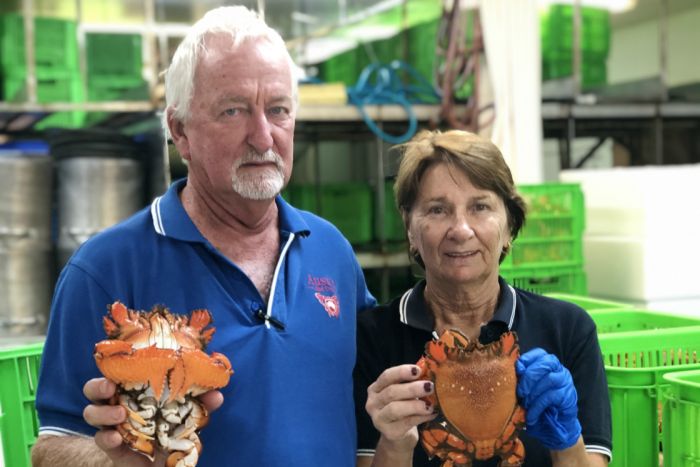
Spanner crabs have been fished to near extinction in many countries around the world, but significant quota cuts were made to keep Australia’s industry sustainable.
The vibrant red spanner crabs are commercially caught in waters stretching from the town of Seventeen Seventy in Queensland, down to the New South Wales border.
Les and Lynn Apps entered the industry 25 years ago.
From a two-person operation, pushing their boat off the beaches of Fraser Island to get their catch, they have built up their business to employ 40 people.
“Queensland should be proud. We’ve got the best-managed and the largest spanner-crab fishery in the world,” Les Apps said.
As the biggest fishing quota holder, the Apps’ company, which trades under the names Fraser Isle Spanner Crabs and Aussie Red Crab, has millions of dollars riding on the industry’s sustainability.
Species rebuilding
And while supportive of Queensland Fisheries management now, Mr Apps claimed that spanner crab numbers were still suffering, from mistakes made in the past.
You might like


“We just don’t want to see that situation again.”
Mr Apps raised his concerns as Fisheries Queensland sought comment on its draft harvest strategy for 2020-2025.
The strategy needs to be implemented by the middle of the year and Mr Apps and his business partner, Jason Simpson, are worried the process could be influenced by pressure to increase fishing quotas before the crab population has time to rebuild.
“I think some of the negative press that we may have had is coming from individual fishermen,” Mr Simpson said.
“It is unfortunately an emotional one [story] where they haven’t managed to stretch their quota out to get to the beginning of the quota year and consequently they’ve got a boat tied up, they’ve got skippers they can’t employ and it’s absolutely tragic,” Mr Simpson said.
Queensland’s commercial catch peaked at more than 3000 tonnes in 1994 but that was not sustainable for the very slow-growing spanner crab, which takes five times longer than a mud crab to be old enough to breed.
“Technically there’s no way of them accurately ageing the lifespan of the spanner crab,” Mr Simpson said.
“What we do know from the thinking from Queensland fisheries is that the most mature crab, heading up towards a kilogram, is somewhere between 10 and 15 years of age and sexual maturity isn’t reached until the age of five years.”
Fisheries Queensland Executive director, Claire Andersen, said her department responded to concerns in 2018, by cutting the industries fishing quota by 48 per cent.
“The stocks were at the lowest point we’ve seen them in the history of the spanner crab fishery,” Ms Andersen said.
Stay informed, daily
“So fisheries Queensland stepped in, worked with industry and identified some changes that needed to be made to help protect the stock and rebuild it over time.”
Ms Andersen said because fishers were not catching anywhere near the number of spanner crabs they were allowed to, in real terms the total allowable catch only decreased by 10 per cent, to 847 tonnes.
In the years that Jason Simpson has been attending the world’s largest seafood trade show in northern China, he has witnessed spanner crabs offerings from other countries dwindle from some undersized specimens, to none.
“We set up a stand at the show in November, we had crabs there, 800g to a kilo and the international seafood fraternity that visited our stand had never seen anything like it, they were absolutely in wonderment.”
Sustainability the key
Les Apps said Australia needs to protect its reputation as the most sustainable spanner crab fishery in the world.
“All other areas, where there’s been spanner crab, they have basically been fished out,” he said.
“We want to make sure that governments are acting responsibly and that managers are making sure that fisheries are sustainable based on good sound statistics and we don’t want personal opinions or situations interfering again.”
Fraser Isle Spanner Crabs and Aussie Red Crab buys spanner crab from five independent fishers and owns another 12 boats.
The industry is highly regulated, with satellite trackers on every vessel and their tenders — a smaller boat used for transportation between a large ship and the shore.
“All our fishermen have to report in one hour before they enter port, how many baskets they have on board, they then have to weigh those baskets and then a report has to be done straight away into how many kilos they have offloaded,” Mr Apps said.
“We have the fisheries inspectors regularly coming down — I mean you cannot bring in one kilo of crab without reporting the exact weight and our factories are all monitored regularly to make sure that we are all doing the right things.”
Ms Andersen said Fisheries Queensland had no plans to change fishing quotas at this stage and decision making would be based on science and surveys of the fishery.
“Last year’s survey showed that catch rates were starting to stabilise, so it’s not getting any worse, but it’s also not recovering particularly quickly as well so we need to continue to monitor that and ensure that the catch levels are set at the appropriate and sustainable level,” she said.
-ABC
Want to see more stories from InDaily Qld in your Google search results?
- Click here to set InDaily Qld as a preferred source.
- Tick the box next to "InDaily Qld". That's it.



