Saving Paradise: Inquiry opens floodgates of local anger
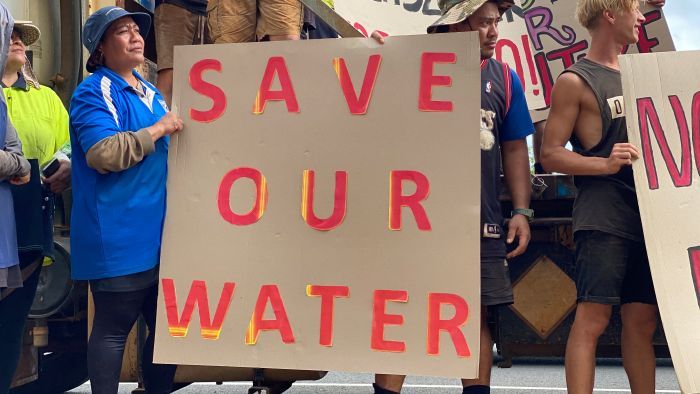
Scores of protesters in Bundaberg have ramped-up their fight for water security, demanding Paradise Dam on the Burnett River be fixed and not lowered.
A Commission of Inquiry into the construction of Paradise Dam, tasked with identifying the root cause of structural and stability issues with the dam wall, is gathering evidence at hearings this week.
Among the witnesses are former engineers, designers and contractors associated with the original construction in 2006.
The dam’s 300,000-megalitre water storage is being reduced to 42 per cent to allow for the spillway to be lowered for safety reasons.
‘We just want it fixed’
Farmer and small business owner, Judy Plath, said protesters want Paradise Dam repaired rather than its capacity reduced.
“Not five metres knocked off, not 10m knocked off. We want them to fix the dam, not knock it down,” she said.
“We want the truth to come about the safety issues.
“Paradise Dam is crucial to this region. It’s the little blokes who will lose out if farmers go backwards and don’t have the water to look after their crops; they won’t be able to employ the people they employ now.”
Bundaberg Fruit and Vegetable Growers treasurer, Joe Lyons, an avocado and macadamia grower, said Sunwater and the State Government seemed adamant the wall was unsafe, but there were still questions about how they came to that conclusion.
You might like


“We don’t want to put anyone’s life in jeopardy but we’ve got to look to the future now,” he said.
“We’d just like to know what exactly is wrong with the dam wall — it survived a significant flood in 2013.
“We have trees that last for 40 years, we just need to sure up our water security.”
Mr Lyons said the turnout at the protest — about 80 people — showed the growing concern over the way the issue was being handled.
“This dam has been a boon for this area and, now that we have uncertainty about it, that’s going to have economic consequences going forward,” he said.
“There’s a lot of people that are frustrated with what’s going on.
“Plus there are a lot of hardworking farmers that can’t make it today because they’ve got to keep the ball rolling [on their farm].”
Mental health fallout
Bundaberg provisional psychologist and farmer, Emma Slater, said anxiety and stress has been crippling the local agriculture sector.
“Farmers can deal with natural disasters like drought, fire and floods, but when water security is being removed from them, that puts people into a very different headspace,” she said.
“We are a family who have invested in tree crops and right now we are questioning whether we even put the trees in the ground due to uncertainty around water security.
“Now we are not just looking at the impact on farmers but it is affecting everyone across our community.”
Stay informed, daily
Slater said she was not aware of any additional mental health support available to those affected, and was worried the economic impact would see people struggle for a long time.
“Right now I’m not aware of any government package that’s been put together to actually deal with the mental health fallout,” she said.
“Our region is already under-resourced in the mental health industry — I have grave concerns for our community.
“This will impact our community and if we don’t have the resources the fallout is going to be massive.
“I would be urging the Government to start stepping up to the plate and start talking about how they are going to help and support the people on the ground.”
Liberal National Member for Burnett, Stephen Bennett, said a crisis support centre was needed to deal with the financial, mental health and water sustainability issues facing the community.
“The Government needs to be in Bundaberg on the ground now while we continue to face taking the top off Paradise Dam,” he said.
The Queensland Minister for Natural Resources, Anthony Lynham, declined to comment during the public hearings, but a spokesman from Sunwater said their “priorities in relation to Paradise Dam are the safety of downstream communities and water security”.
Farm expansions on hold
Meanwhile macadamia farmers, such as Andrew Lewis, have been putting expansion plans on hold amid the uncertainty.
“We moved to Bundaberg [from Brisbane] in 2009 because of the opportunities that Bundaberg offered, and that was a wonderful climate with amazing water security,” he said.
“So far we’ve planted 30,000 trees and we’ve got 18,000 trees left to plant this year — we’re looking at our first commercial crop from them this year.
“Initially I hoped it wasn’t true … it immediately changed how we’re going to irrigate all of our future trees.”
Real estate agent, Malcolm Topp, said the discussion had put a lot of fear into the market and had scared off investors.
“[There is] fear, uncertainty, discontent and angst in general right across the broad community,” he said.
“All this area is built around rural industry [and] a lot of those workers live in town.
“The farms might not be selling but houses in town might not be selling either and the lifestyle blocks [won’t be selling either] because no one’s game to do anything until someone comes up with a definitive answer.”
The hearings continue in Bundaberg this week.
– ABC/Megan Hughes, Nicole Hegarty, Scott Lamond
Want to see more stories from InDaily Qld in your Google search results?
- Click here to set InDaily Qld as a preferred source.
- Tick the box next to "InDaily Qld". That's it.



