Can this invention allow police to conduct roadside eye tests?
Drivers’ eye sight could be the next focus of road-side testing, if a Hobart optometrist’s invention is taken up.
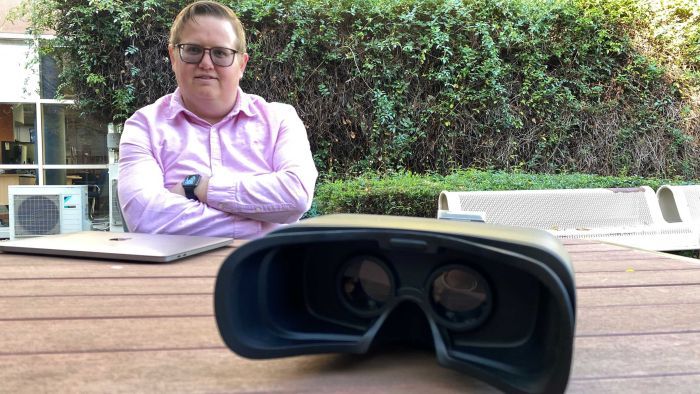
Ben Armitage has been frustrated by people not adhering to the vision requirements for driving.
“I regularly have a conversation with someone where I say ‘you need to wear glasses to drive’ and they tell me ‘I’m not going to do that’,” he says.
“And in Tasmania there’s nothing really much I can do about it.”
Research conducted in Melbourne and Brisbane showed up to 8 per cent of drivers did not meet the legal standard for vision.
The frustration prompted Armitage to look at ways to improve road safety by encouraging people to wear their glasses.
“So I was thinking of a way that we could get a check to the side of the road that enabled someone to check whether someone was legal to drive,” he said.
“Basically, to do a quick eye test on the side of the road in a few seconds which said ‘yes, you’re okay to drive’ or ‘no, you’re not okay to drive’.”
You might like


Road-side test developed
Armitage worked with designers in Melbourne and has now developed the third prototype of the patented device he calls Acuidrive.
“I’m an optometrist, so the optics — how the lenses work, how the light moves — I can do that, but the ergonomics of it and the practicalities, I’ve had a lot of help both from friends in the police force and also these designers in Melbourne,” he said.
Australian drivers need to meet what is called 6/12 vision, reading letters about twice the size of 20/20.
The device is held up to a person’s forehead, and when they apply pressure a panel illuminates inside, revealing five small letters.
It is designed to replicate the standard six-metre reading test done in optometrists’ rooms.
Armitage is in talks with the Queensland University of Technology about trials to prove the device’s accuracy.
“We need to make sure that if we are going to use this to test people’s vision on the side of the road, that if you can’t see using this device, you wouldn’t be able to see using a test chart,” he said.
Stay informed, daily
“Once we have that stage, I think the next step is to try to get it into the hands of the police on a trial basis, just to do almost like random breath-testing to find out how big the scope of the problem is.”
Current methods ‘not reliable’, say optometrists
Ben Hamlyn, an Optometry Australia board member, said it was difficult to accurately test eyesight on the side of the road.
“Simply asking them to tell the police officer if they can see a street sign is not appropriate in most circumstances and it’s not reliable enough,” he said.
“So there is an enforcement issue.”
Hamlyn said research from the United Kingdom showed around 26 per cent of people admitted to not wearing glasses to drive when they should.
“Provided the device is precise and accurate enough to reliably measure someone’s vision, I believe that it would benefit the community for police to be able to enforce the vision requirements that already exist,” he said.
“And it may encourage those people who are not wearing their glasses to wear their glasses to drive.”
In Tasmania, drivers’ vision is tested when they first get their licence and then when they turn 75.
It is up to the individual to report if their eyesight changes during the decades in between.
RACT’s executive general manager Stacey Pennicott said the idea of the Acuidrive device was sound and she was hopeful it would help improve road safety.
“That’s a long period of time from when most people get their driver’s licence to the time that they finish driving,” she said.
“It’s obviously an area that’s untapped in terms of its ability to improve our road safety statistics.”
– ABC / Selina Ross
Want to see more stories from InDaily Qld in your Google search results?
- Click here to set InDaily Qld as a preferred source.
- Tick the box next to "InDaily Qld". That's it.



