The voice heard from Struggle Street to Kirribilli House
By Don Woolford in Sydney
Love him or hate him – few people are short of an opinion about Alan Jones, who retired this week after 35 years on radio. But the former Brisbane teacher and national rugby coach leaves an indelible legacy on talkback radio, writes Don Woolford
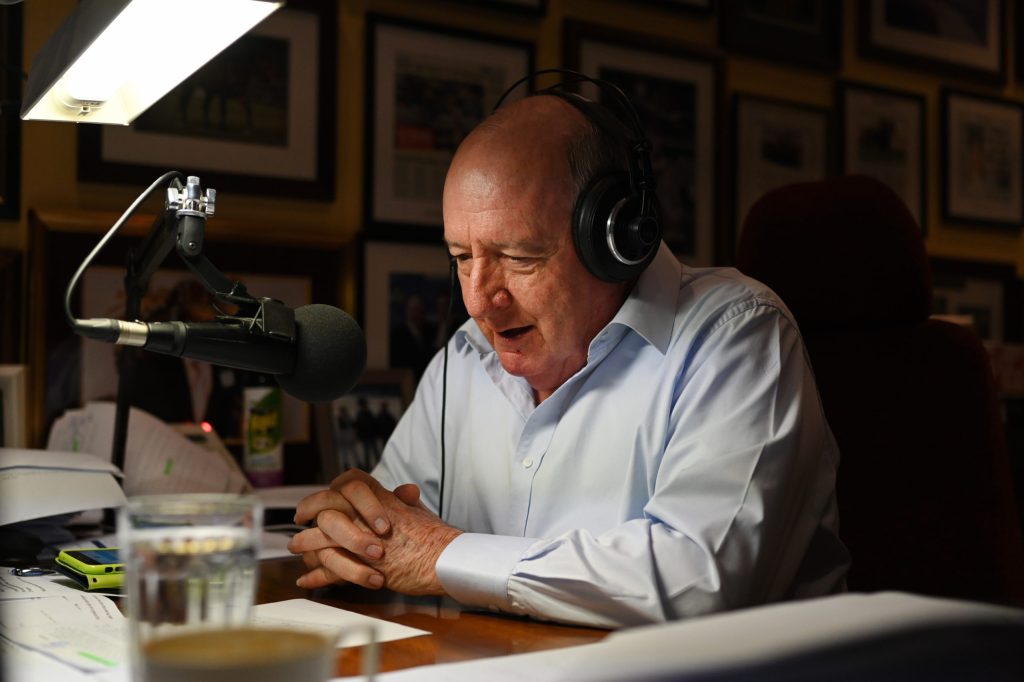
Even a week before his retirement, Alan Jones was in trouble with broadcasting authorities
Sanctioned for inaccurate comments on climate change and for breaching decency standards by suggesting Scott Morrison shove a sock down Jacinda Ardern’s throat, it seemed a fitting way to bring an end to the most successful, and controversial, career in Australian radio.
Upon announcing his retirement earlier this month, politicians called in to his 2GB show to congratulate and eulogise him. Not just all were from the Liberal Party. Former Labor leader Mark Latham called him a “truly great person” and lauded his “phenomenal” charity work.
From improbable plaudits from Usain Bolt and Roger Federer to his battlers who rang in and wrote to tell Jones how much they’ll miss him, the reach which helped him to a record 226 ratings wins was imposing.
Others had a very different view. One letter writer to the Sydney Morning Herald called him a bully and bigot, another called him misogynist. Many others have said far worse.
Opinions on Jones rarely featured fence sitting.
In his 35 years at Sydney radio stations 2UE and later 2GB, Jones became the self-appointed and outrageously dogmatic voice of the battler, constantly in trouble with the law while feared and courted by politicians.
But his early years were tough on the family’s hard scrabble farm on Queensland’s Darling Downs and it was only through a bank loan that Jones was able to go to Toowoomba Grammar.
After teachers college and a stint teaching primary school, Jones in 1963 started at Brisbane Grammar School, where a familiar pattern was set.
You might like


Jones was an inspiring teacher and a highly successful coach in tennis, athletics and rugby.
But he played favourites. While it was great for the insiders, others feared him.
He moved to The King’s School in Sydney in 1970 and the pattern was repeated.
He coached King’s to a rare GPS rugby premiership, but his passionate ways divided staff and boys.
King’s finally asked him to go.
For some years Jones bounced about. He ran a regional airline from Quirindi, he did a one-year diploma of education at Oxford, was a speechwriter for Prime Minister Malcolm Fraser and tried without success to win state and federal parliamentary seats. In 1981 he became chief of the NSW Employers’ Federation.
Rugby then steered him toward radio.
In 1983, Jones was appointed Manly rugby club’s first grade coach and, against all expectations, took it to its first premiership in 32 years.
He became Australia’s coach in 1984, leading the Wallabies to a grand slam-winning tour of the British Isles and breaking a 39-year Bledisloe Cup drought in 1986.
But, again, there were favourites, and in 1988, despite a 23-7 Test-winning record, he was deposed.
While Wallabies coach, he found he was good at his regular radio appearances and in 1985 settled at 2UE as a morning host of growing audience and influence.
He didn’t have the golden tonsils of his great rival John Laws. He lectured, he nagged, he never appeared to have a moment’s doubt. And he captured the prejudices of his predominantly working class western Sydney audience.
Stay informed, daily
David Leser, in a 1998 profile, wrote that his technique “is to blend an unpredictable mix of right-wing authoritarianism with popular outrage against predictable targets such as government bureaucracy, big banks, environmentalists, welfare recipients, ABC listeners, Aboriginal activists, the judicial system and selected politicians”.
Politicians were anxious to keep the dangerous beast sweet, though some think they over-estimated Jones’s power, particularly in later years when his audience was shrinking and ageing.
He was constantly in trouble in the courts.
Among those he allegedly defamed were rugby league referee Bill Harrigan, Australian Olympic Committee chief John Coates, Queensland Premier Campbell Newman, rugby union chief John O’Neill and Aboriginal leader Pat Dodson.
He, 2GB and Brisbane station 4BC were ordered to pay $3.4 million in damages for defaming the wealthy Toowoomba Wagner family by saying they were responsible for the deaths of 12 people in the 2011 Grantham floods.
He was forced to apologise for inciting racial hatred after reading a message calling on people to come to Cronulla “to support the Leb and wog bashing day” and, separately, for calling Lebanese Muslims vermin and mongrels.
He outraged politicians, perhaps most notably when saying at a private function that Julia Gillard’s father had died of shame because the prime minister was a liar. He wanted Gillard, Sydney Lord Mayor Clover Moore and then Greens leader Bob Brown put into chaff bags and taken out to sea.
Yet though he was usually outrageously conservative, he was on the Greens’ side when it came to opposing coal seam gas mining in agricultural regions.
And he wielded power on behalf of both wealthy mates and the poor and weak.
Jones was twice embroiled in controversies over cash for comments, an ethically smelly practice which helped make him very wealthy. Not that he needed money. He jumped ship to 2GB in 2002 for $4 million a year, plus a good slice of the station.
Yet quite a lot of his wealth went quietly to charities.
His membership of the Order of Australia in 2004 was awarded for his service to the media, sports administration and charity work.
What wasn’t in doubt was his ferocious work ethic. He’d normally get up at 2am to prepare for his role as king of breakfast radio.
It was that relentless toil which doctors warned would have dire consequences. He’d already had serious health issues and the medics told the 79-year-old he had to stop, or he’d drop.
NSW premier Gladys Berejiklian was one who called in to gush when Jones announced his retirement, jokingly telling him that was the first time he’d listened to the experts.
Want to see more stories from InDaily Qld in your Google search results?
- Click here to set InDaily Qld as a preferred source.
- Tick the box next to "InDaily Qld". That's it.



