Orange plume prompts calls for research into environmental, health impacts of mining blasts
Mining blasts are a common sight around Moranbah, but an unusually orange-coloured plume has prompted calls for more research into exposure risks.
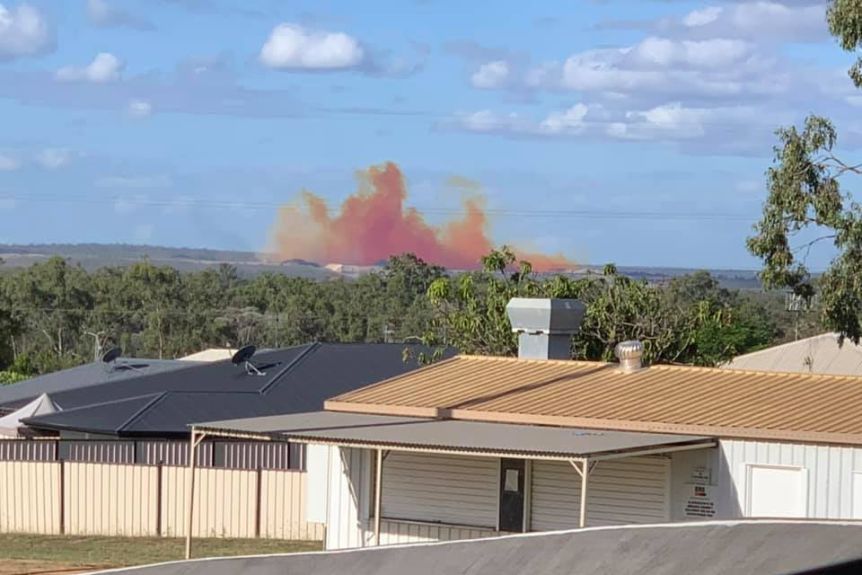
Mining blast plumes are a common sight around Moranbah in central Queensland, but when a recent blast produced a bright orange plume some residents were left wondering whether the oddly coloured fumes were harmful to their health.
Blasting is used regularly at mine sites to break ground.
Experts say it is not likely to be of immediate concern, but the impacts of long-term exposure to mining blasts are largely unknown because there is little to no research on the topic.
Resident Luke Collings said he could see an unusually orange plume from his home late last month.
“It was quite confronting because it did initially appear to be reasonably close to where the housing area is and it was a bit surprising to me that that would be happening,” Collings said.
“I know several people who are quite concerned about it, but some people will shrug it off and say ‘well if you live out here, that’s just what you have to deal with’.
“But it doesn’t answer the question as to exactly what we may be breathing in.”
You might like


The blast happened on May 31 at the Isaac Plains Coal Mine, about 8km east of Moranbah and 4km north of the Peak Downs Highway.
Operator Stanmore Coal said the fume was contained within a 1.2km fume exclusion zone and had no impact on the highway or nearby residences.
The company said it blasts four times a month, rarely has a “fume event”, and the orange gas occurred because nitrogen combined with oxygen.
Dr Gunther Paul from James Cook University, an air quality and respiratory health researcher, said the orange plume was likely a sign nitrogen dioxide was being released.
“Nitrogen dioxide is harmful to humans. It’s a known toxin,” he said.
“I wouldn’t initially say we have to be concerned [by the orange blast] but we want to better understand health impacts.
“We can’t tell if that is a significant risk or not … because we haven’t conducted the research.
“We need to look at this pollutant in explosions because explosions create a very large density of those gasses over a very short time.”
Stay informed, daily
Paul said waste oil from mine sites had become a popular ingredient in mining explosives for financial and environmental reasons as the oil replaced up to half the diesel required.
Paul said there had not been enough research into the environmental and health impacts of mine blasts, and the use of waste oil.
“If we explode waste oil with all of its contaminants then naturally those contaminants have to go somewhere,” he said.
He said mining companies could be doing more to keep communities informed about incidents such as the recent orange plume.
“It is a public health issue, it’s not just an occupational health issue,” Paul said.
Concerns were raised previously about the air quality in Moranbah after high levels of microscopic dust particles were recorded in 2018.
Paul said models for mining’s effect on air quality did not take into account the effects of blasts and there were plans to start researching this soon.
In a statement, Stanmore Coal said all personnel were withdrawn from exclusion zones before the blasts.
The Queensland Mines Inspectorate said it regulated blasting in mines and mine operators had obligations to ensure blasts were done safely and securely.
Luke Collings, the priest in charge of the Moranbah Anglican Parish, said most locals were aware of dust and air quality issues.
“You can’t wash your car without it immediately being covered in dust by an hour later,” he said.
“It’s something that’s I think not as widely talked about because there’s not that solid information available and easy to find.
“There are questions that I think resource towns need to keep grappling with and there aren’t easy answers for a lot of them.”
– ABC / Angel Parsons
Want to see more stories from InDaily Qld in your Google search results?
- Click here to set InDaily Qld as a preferred source.
- Tick the box next to "InDaily Qld". That's it.



