Burning issue: Ipswich residents say waste incinerator will just encourage more waste
A proposed $4 million waste-to-energy incinerator, which would turn non-recyclable items into electricity, has residents at Ipswich, west of Brisbane, up in arms over concerns it will encourage people to create more waste, rather than recycle it.
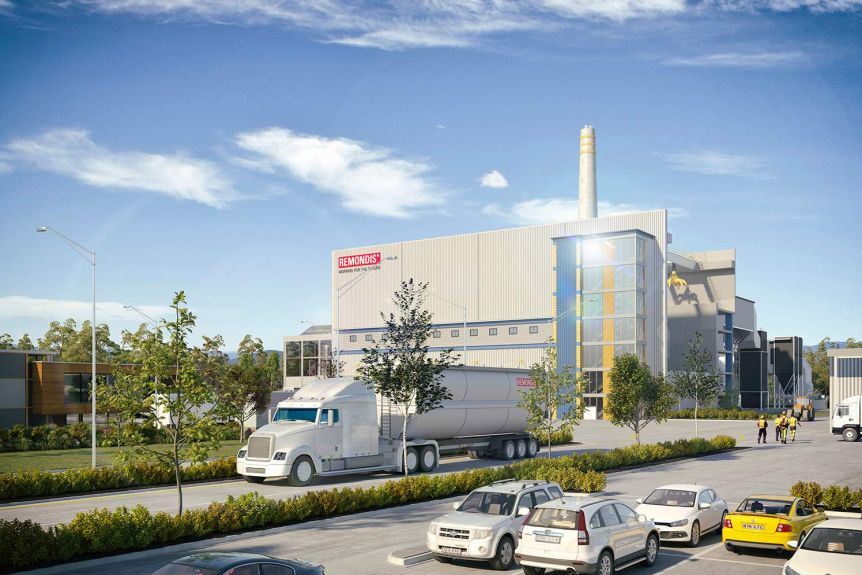
Residents in Ipswich have vowed to continue fighting against a $400 million waste-to-energy incinerator that has been proposed for Swanbank at Ipswich, west of Brisbane.
The project’s proponents, German waste company Remondis, said the facility would take 50,000 tonnes of waste per year and create 50 megawatts of electricity which could power up to 50,000 homes.
But residents in the surrounding area where the facility is to be built fear the incinerator will encourage people to create more waste, rather than recycle it.
The project passed its first hurdle earlier this month when the Queensland Government declared it a coordinated project.
‘We have had enough’
Jim Dodrill, president of Ipswich Residents Against Toxic Environments, said there’s widespread concern among the group that the facility will be harmful to residents.
“Scientific data from around the world has shown that waste incineration is not good for human health and we oppose it very much for that reason,” Dodrill said.
“We have had enough of the reputation of Ipswich as the dump capital of Australia.
“We believe it’s time for other places to shoulder the burden and manage their own waste — we shouldn’t have to be managing everybody else’s waste.”
In a statement, a spokesperson from Remondis said the incinerator would have a “highly advanced capture system” that would operate in line with the “world’s best practice”.
You might like

“Testing would be rigorous and ongoing, and monitored constantly by authorities,” the spokesperson said.
In the past, waste-to-energy (WTE) incinerators have been billed as a viable, green alternative to landfill and have become widespread across Europe, following a ban on landfill sites.
“What has been proven around the world is that waste-to-energy incineration decimates the local recycling industry because they need to keep those furnaces burning 24/7,” Dodrill said.
“So what they will do is take waste from anywhere and everywhere to keep it happening.
“It’s actually generating demand for more waste, which is what we are trying to get away from.”
‘We are continuing to suffer’
Geoff Yarham, the group’s secretary, said he’s concerned about how the Queensland Government could ensure an incinerator complied to environmental standards.
“Two years ago the State Government put in the odour abatement task force. It cost $3 million of your and my money and to date, they haven’t stopped any of the odours in the Ipswich area.
“We are continuing to suffer. We have no faith in them [the Queensland Government] managing and overseeing all this supposed technology.”
Professor Bernadette McCabe, principal scientist at the University of Southern Queensland’s Centre for Agricultural Engineering, said WTE technology was not as simple as “trucking in rubbish” and burning it.
“Thermal energy is regarded as a technology which utilises residues at the bottom — [it’s] the last resort in the waste hierarchy,” McCabe said.
“So the focus should be on re-purposing, re-manufacturing and recycling materials before they end up at a waste to energy facility.
“The type of waste that goes into it are those non-recyclable materials that don’t have a value, which are then burned to generate electricity.
“The emphasis is on resource recovery in the first instance, and then energy recovery. This, I feel, is the important aspect that people need to understand.”
Stay informed, daily
McCabe said WTE technology can certainly help reduce waste and recover energy from non-recyclable items.
But she said there are concerns that waste that could be recycled in a more economic, environmentally friendly way, could end up in the incinerator.
“Internationally, experience tells us that when waste can’t be prevented or recycled, recovering its energy is in most cases preferable to landfill,” Professor McCabe said.
She said food waste, which typically has high water content, and organic waste, which often has low energy value, would not work in a WTE incinerator.
Instead, those types of waste should instead be better utilised to produce other products such as fertiliser using different technologies.
McCabe said Australia had not reached the same point as Europe, where the banning of landfill in Europe sparked the proliferation of WTE technology across the continent.
“In the meantime, we [Australia] should be identifying those technologies which keep materials in use longer, and make them more mature, so that we can recover our resources at a higher value rather than by simply burning them,” she said.
McCabe said she expects WTE technology to play a greater role in the future, as Australia gradually moves away from landfill, but developing the sector needed to be done in an environmentally and socially conscious way.
‘It’s far from a rubber stamp’
Lance McCallum, the new member for the Ipswich suburb of Bundamba, said the announcement of the proposal as a coordinated project doesn’t necessarily mean it will go ahead.
“It will be subject to the most rigorous assessment process available under Queensland law, as well as approved by its relevant Local Government laws and any Federal Government requirements,” McCallum said.
“Being a coordinated project is far from a rubber stamp.
He said since the Palaszczuk Government had been elected, six projects had been approved, six rejected and 12 that were still under consideration.
McCallum said the company needed to demonstrate to every level of government and the community that the project would be beneficial.
“We need to make sure that any waste proposal doesn’t encourage greater use of waste, nor should it in any way dissuade reuse or recycling when it comes to waste in our community,” McCallum said.
“Here in Queensland, we are only recycling about 30 per cent of our waste so we have a lot of room for improvement there.”
– ABC / Baz Ruddick
Want to see more stories from InDaily Qld in your Google search results?
- Click here to set InDaily Qld as a preferred source.
- Tick the box next to "InDaily Qld". That's it.