Clean jobs scheme aims to create 20,000 new jobs in Queensland
Up to 20,000 jobs could be created in Queensland through a plan to tackle climate change and more than $1 billion in public funding, according to a study commissioned by the Climate Council.
Dubbed the Clean Jobs plan, the scheme would create about 76,000 jobs nationally, according to economist Andrew Charlton, and come at a cost of $1 million for every 7.2 jobs.
Modelled by Charlton’s AlphaBeta, the plan identified 12 clean policy options that he said would create jobs quickly, in places where they were needed and for people who needed them most.
But they would need billions in private funding as well.
“The job creation could start immediately and continue over three years,” Charlton said.
He said the 12 policy areas were relatively efficient job creators because they focussed on labour-intensive industries, leveraged private co-financing and avoided capacity constraints – for example, skills or material shortages that may otherwise increase project costs.
In Queensland, the major job creators included ecosystem restoration and revegetation (5000–5500 jobs) and installing utility-scale renewable energy (1800–2200 jobs). The Queensland Government already has a policy of supporting renewable energy projects, but Charlton’s plan claims every $1 of public funding for renewable schemes could attract $3 of private funding.
You might like


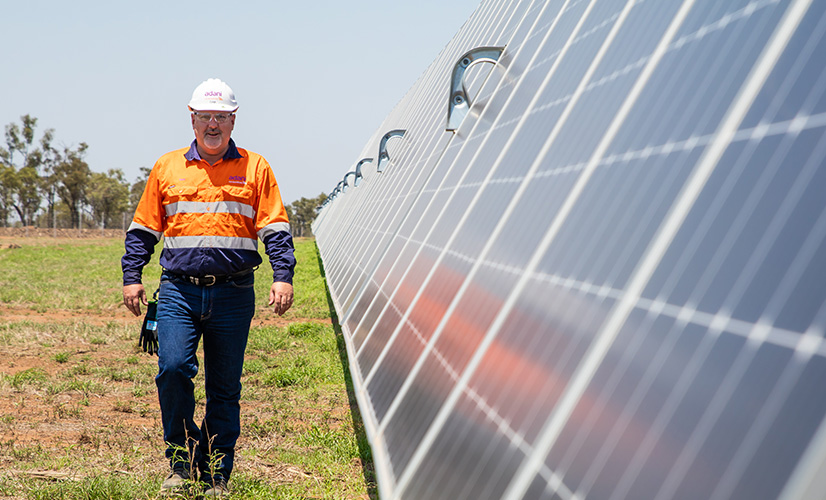
It cited the example of APA’s Darling Downs Solar Project, which was partially funded by the Australian Renewable Energy Agency. That project was among 12 estimated to have unlocked about $1 billion in private funding.
Charlton, who previously worked as Kevin Rudd’s economic adviser during his term as prime minister, said Queensland’s diverse ecosystems and large-scale carbon sink – from old-growth forests and grasslands, to complex marine ecosystems – provided opportunities for significant restoration and revegetation projects.
“Governments could directly fund or subsidise conservation efforts which will increase the ability of natural ecosystems to serve as carbon sinks. This includes restoring and revegetating forest ecosystems as well as wetland ecosystems. The effectiveness of ecosystems to absorb carbon ccould be maximised through revegetation and amending irrigation architecture,” the plan states.
However, an issue for Queensland was its remote and regional communities which could limit the effectiveness of some policies due to localised skill shortages in those communities. Policies which can therefore be locally tailored, such as residential retrofitting, or are targeted investments, such as green hydrogen pilots, were more promising.
“Queensland has seen steep job losses throughout the COVID-19 pandemic, but with the right policy measures, thousands of jobs can be created across the state in ecosystem restoration and large-scale renewables, transmission and battery storage.
“Every dollar of public investment in large scale renewables would unlock $3 of private investment in the economy.”
Stay informed, daily
The development of renewable energy would generate up to 2200 jobs and another 1600 jobs would be created in making homes more energy-efficient.
The research and development of hydrogen projects would create another 350 jobs.
Across Australia, 42 per cent of the job opportunities identified in the plan were located in regional areas.
”Economic stimulus can pay long-term dividends and set us up for the future by creating jobs, kick-starting the economy and tackling climate change simultaneously.
“Investments in clean jobs will have a lasting benefit for the economy, reducing energy costs, producing reliable clean power and developing new industries.
“The opportunities identified in our modelling work are shovel ready and will make a difference throughout Queensland.
“One-third of the jobs would require less than 12 months of retraining, meaning that workers who lost their jobs because of the COVID-19 crisis could be rapidly employed,” Charlton said.
Climate Council chief executive Amanda McKenzie said the restoration and revegetation works in Queensland would also involve protecting the Great Barrier Reef which would in turn help the tourism industry.
“Jobs in ecosystem restoration can also protect agricultural land for generations to come,” she said.
The report calls for the creation of renewable energy zones that would be able to lure industry to regions.
“By declaring a renewable energy zone in the Darling Downs, the Queensland Government could help to accelerate investment,” McKenzie said.
“This will support local jobs and secure a steady pipeline of renewable energy projects in the Toowoomba area and broader region.”
“The Clean Jobs Plan is unique because of the speed at which it can get people back to work. It sets us on a practical, jobs-rich path and focuses on areas most in need. It sets us up for the future, by creating jobs and tackling climate change. It’s a win-win solution.”
Want to see more stories from InDaily Qld in your Google search results?
- Click here to set InDaily Qld as a preferred source.
- Tick the box next to "InDaily Qld". That's it.



