Feedlots on decrease as global uncertainty hits beef markets
Uncertainty in global beef markets is starting to flow through to Australian feedlots, with the number of cattle on feed drastically decreasing.
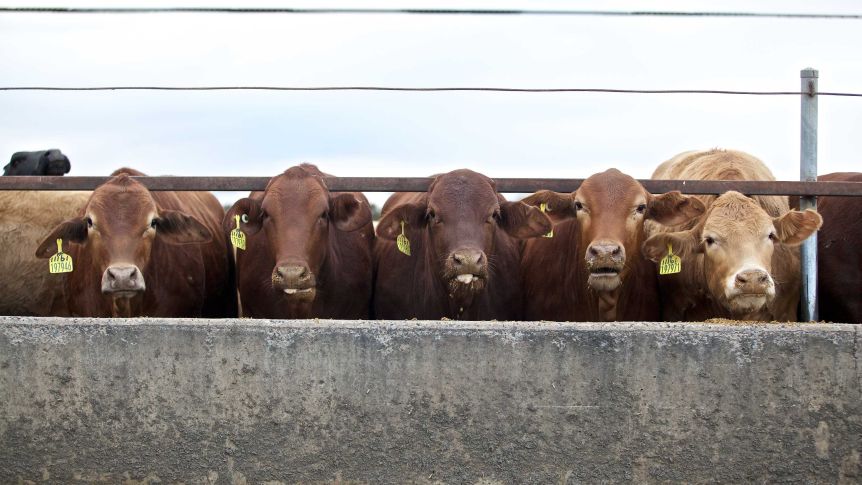
At Lotus Park Feedlot, 200km north of Rockhampton, the number of cattle on feed has halved since April.
Manager Harry Kemp said when COVID-19 hit, forward contracts for meat started tapering off, resulting in abattoirs reducing demand for cattle.
“We are normally a 6000 to 6500-head feedlot, but at the moment we have between 3000 and 4000 head of cattle on feed, so that is sort of half,” he said.
Nationally, the number of cattle in feedlots has been declining since the start of the year, with numbers dipping below 1.1 million head of cattle on feed for the first time in two years.
President of the Australian Lot Feeders’ Association, Bryce Camm said numbers dropped from nearly 1.4 million head on feed at the end of 2019 to just over one million earlier this year.
“The January to March quarter saw a 12 per cent reduction in cattle on feed after almost two years of record growth in numbers,” he said.
“That was largely because of the rainfall events through February, which saw a lot of people hold on to cattle.
“But it will be interesting to see what the June quarter results are when they are released in about a month’s time.”
Rain boosted competition
The rain in February and March also boosted Australian cattle prices as graziers, particularly from New South Wales, competed against feedlots and abattoirs for the same cattle.
You might like


“We normally buy [cattle] out of Gracemere, Charters Towers, Emerald and even further west,” Mr Kemp said.
“We have been seeing a lot of NSW operators come up to these cattle sales.”
Kemp said NSW graziers could afford to pay more for cattle because they did not have the added pressure of high grain prices.
“[Queensland feedlots] are [locked in to contracts set at the] old crop price and it’s still about $400 a tonne,” he said.
“Whereas with a big winter crop in NSW, people are paying grain prices that don’t look too high.”
‘Volatile’ market adds to uncertainty
Gympie-based meat processor Terry Nolan said the market was currently too “volatile” to pay top dollar for cattle.
“There are as many cattle out there as you want to buy,” he said.
“Everyone says there are shortages, but that’s code for saying the cattle that are out there are probably making too much money.
“It is the price pressure that’s stopping people, because sure the herd is down.
“But if the herd was down and cattle prices were up and you were confident about selling the meat, you’d just go out there and buy [cattle] regardless.
“But we’ve seen a lot of processors very tentative, and it’s probably even worse in the south.
“If you talk to Victorian processors, a number of them are having stand-down days or part shutdowns, whereas in Queensland we are a bit fortunate in that … about 60 per cent of the national herd is in Queensland, so we’ve managed to still find enough cattle.”
But Nolan said some Queensland abattoirs had reduced kill shifts, depending on the market they served.
Stay informed, daily
“There’s a whole lot of things at play and it’s hard to put your finger on any one thing to say, ‘Yes, that’s why abattoirs are slowing’ — because for different reasons, different abattoirs are slowing,” he said.
“Obviously we’ve seen some plant suspensions with China over labelling and other issues — that would cause a slowdown, you can’t just create a market overnight.
“We’ve seen an appreciation in the Australian dollar, so that’s had a bit of an effect.
“The COVID issues around the world have had an effect and made freight difficult at times, whether it be sea or air freight.
“And in the China market, we [Australia] have triggered the safeguard tariff again, so the import tariff for China has gone from 4.8 per cent up to 12 per cent.
“So there’s all sorts of things at play.”
US COVID-19 situation impacts feedlots
Also impacting Australian feedlots and abattoirs is the situation in the United States, where there is a backlog of cattle in feedlots waiting to be processed after the pandemic forced abattoirs to shut.
Kemp said Australia was “a little fish in a big pond” when it came to the global beef market.
“If America and Brazil come back online, they have a lot of cattle sitting on feed waiting to be killed,” he said.
“There will be a lot of meat that will come onto the world market.”
But Nolan is not expecting the impact to be all bad.
“I think there will be a suppression in world beef prices, and yes, it will affect Australia,” he said.
“But I guess the softening effect there is if there’s an extra amount of fat grain-fed beef coming on the market, the US still requires some of our leaner trim to balance up their fat trim for the quick service restaurant trade.
“So it’s very hard to quantify the size of the impact on Australia, but I think what we’re saying is, there’s room for caution.
“I wouldn’t like to plough in and buy my years’ worth of cattle now — I think I’d be a bit more conservative, buy a few now and buy a few later.”
Despite the challenges, Camm did not expect Australian feedlot numbers to decrease much more.
“From my perspective, I think we’ve seen the level out,” he said.
“If I was brave enough to make a prediction, I think we will see a stabilisation of cattle on feed somewhere around the million head mark.”
– ABC / Lydia Burton and Meg Bolton
Want to see more stories from InDaily Qld in your Google search results?
- Click here to set InDaily Qld as a preferred source.
- Tick the box next to "InDaily Qld". That's it.



