The business of winning: Why boardroom politics is the greatest game of all
Running sport like a business is all well and good, until the scoreboard suggests you’ve started to drop the ball, writes Michael Blucher
So, three down, perhaps a few more yet to fall. And we’re only 10 rounds into the season. Cut-throat business, rugby league.
What sort of insanity would drive anybody towards a career as an NRL coach?
Without wanting to cast a pall of gloom over the surviving 13, I reckon there’d be a few others who are “as nervous as a long-tailed cat in a room full of rocking chairs”, to borrow a phrase from the great Jason Hetherington, Queensland State of Origin stalwart, and the embodiment of all good things Maroon.
Patience and professional sport – not often they’re found to be cosy bedfellows these days.
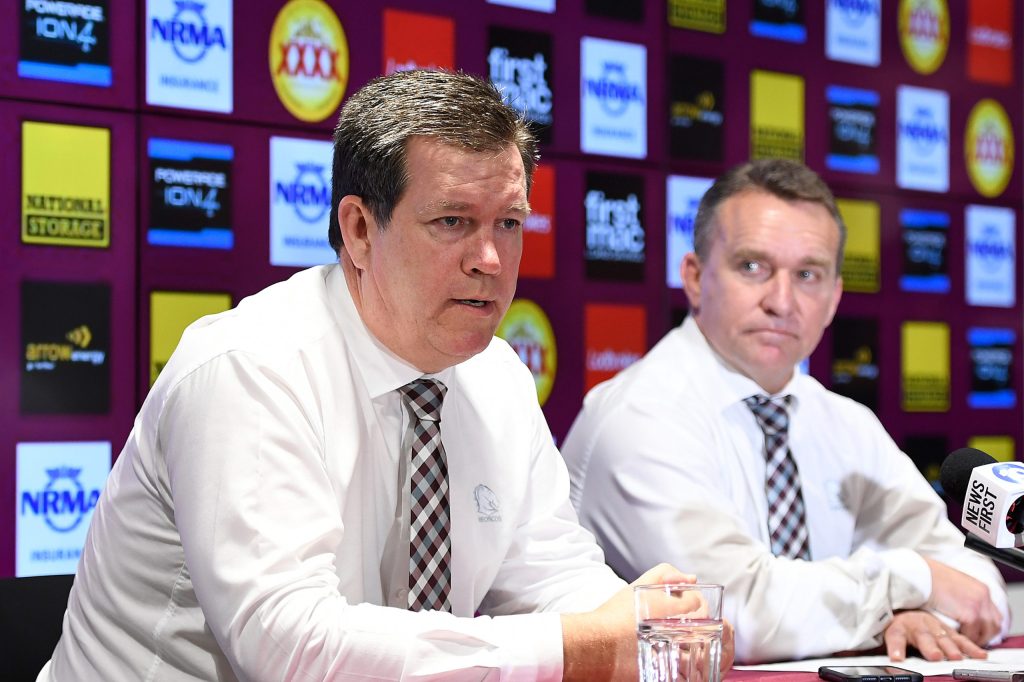
As the witch hunt continues into the long-tailed Anthony Seibold and his stuttering Broncos, you may have noticed the angry eyes are now zeroing in on the club’s board.
More and more disgruntled types are asking – who are the people steering the ship? And out of deference to Peter V’landys, what do they know about “Rugbah Leeg”? Karl Morris – the chairman? Who’s he, and how many first-grade games did he play?
Even Darren Lockyer, club legend and icon of the game, a bloke with a statue in his honour outside the stadium, is under siege, after an aggrieved shareholder posed a direct (let’s call it hostile) question about his board qualifications at the club’s recent AGM.
“It is interesting that the two great athletes on the board do not appear to have any real commercial identifiable skills in corporate leadership beyond their undoubted previous ‘on field’ skills,” Ross Johnston, a veteran Brisbane accountant wrote, lumping Lockyer with fellow board member, retired netballer Vicky Wilson.
Not discounting every shareholder’s right to ask the difficult questions, I’d respectfully suggest the venerable Mr Johnston might find it hard to identify Lockyer from Warren Buffett or Woody Woodpecker. But that’s a discussion for another day.
You might like


The broader question remains – exactly what is the “ideal” make-up of a board whose responsibility it is to govern and guide the financial fortunes – and ultimately the on field performance – of our high profile sporting franchises?
The logical leaning (against a backdrop of diversity and inclusion, of course) is towards a liberal sprinkling of complementary and supplementary skillsets, covering off all the basic business building blocks: Finance, legal, sales and marketing, human capital, risk management, compliance and governance, blah blah blah.
In short, draft in a bunch of well-respected professionals at the top of their game, and watch ’em fly. Sport, after all, is big business these days, so you need business people running the show.
Well, yes and no.
The glaring omission from that formula is somebody with an intimate understanding of high performance, and the environment that’s required to achieve it. Somebody like …let’s see… Darren Lockyer? Or in cricket circles, Michael Kasprowicz, who’s just made a dignified exit from the board of Cricket Australia, uncomfortable with the general direction of the administration.
The other crucial point – as much as we all bang on ad-infinitum about the parallels between sport and business, and how one shadows the other, there’s an important distinction that needs to be made.
Business is rational, sport is emotional.
Monday to Friday, we make calm, rational, commercial decisions. Come the weekend – game time – a different circuit of our neurological wiring takes over. We drop the guard, we invest in sport because of the way the contest makes us feel.
The excitement, the pride, the euphoria of a narrow win, the shared tears of a last-minute loss. High or low, sport triggers an emotional experience.
And when emotion takes over, rational decision-making often takes a back seat.
Parlay that reality into a club boardroom, and there’s a risk that sharp, rational business minds, nobbled by emotion and the obsession with winning, become involuntarily blindsided.
There are countless examples of eminently successful business types who, as they arrive at the stadium on a Friday night, park their brain at the entrance to the corporate box.
Stay informed, daily
Wrap a red and black or a maroon and gold scarf around their neck and instantly, it’s like somebody’s removed their head and replaced it with a pumpkin.
Look at some of the sponsorship “investments” they make. Captains of industry become just like everybody else… fans.
And as one former NSW Origin player used to say, having spent years watching board members of his club in the dressing room after the game, “the bigger the fan, the bigger the problem”.
So that’s the first point – successful business people can but don’t always make successful board members. Some get intoxicated by the smell of the linament, and forget why they are there in the first place.
Funnily enough, in the same way that too much passion can be perilous, so too can zero knowledge or appreciation of the game. This is potential pitfall No 2.
To contribute meaningfully, board members must have some level of affinity with the sport, starting with a sound understanding of the culture and the psyche of its constituency.
There was a very awkward moment in the boardroom of a major Queensland football code a few years back when, at the end of the meeting, the chairman asked if there was any other business.
“Yes, I’d like to raise something,” a newbie board member piped up, eager to impress. “It’s been brought to my attention that one of the players is being given a pain-killing injection before each game. From a player welfare perspective, this concerns me greatly.”
Silence.
The rest of the room didn’t quite know where to look. In any heavy contact sport, anti-inflammatory injections are not only commonplace, they’re inevitable, particularly towards the end of the season, when some of the battered bodies are literally being held together by strapping tape.
“Thanks – we’ll pass that on,” the chair concluded, and quickly shut down the meeting.
“The board member’s crime was not knowing a single thing about the sport they’d been charged with administering,” one former “colleague” said. “The bigger mistake was revealing it to everybody in the room. They quickly labelled themselves a lightweight who wasn’t smart enough to know what they didn’t know.”
Which leads me seamlessly to a third staple of board disfunction – directors, masters of their alternative domain, not being prepared to ask questions and build on their existing industry knowledge.
The irony is that board members are permanently surrounded by passionate full-time employees, many of whom are dealing daily with the issues that are being batted around at board level.
Canvassing the thoughts of those at the coal face – people on the same team. That couldn’t hurt, could it? Remarkably, it rarely happens. In my experience, most of the board member questions are directed towards the players, the superstars of the game.
The inner sanctum of professional sport. A heady mix of talent, power, experience, knowledge, ambition and ego, with a healthy dollop of emotion stirred in.
With the financial pressures associated with COVID-19 continuing to play out, you can safely predict the Brisbane Broncos won’t be the last sporting board fielding difficult questions in 2020.
The key to excellence – listening, learning and in the heat of the moment, keeping the emotions in check.
Want to see more stories from InDaily Qld in your Google search results?
- Click here to set InDaily Qld as a preferred source.
- Tick the box next to "InDaily Qld". That's it.



