How schoolyard thieves helped build a local sporting goods empire
Solving the problem of disappearing schools sports equipment has helped Brisbane-based HART Sport clock up nearly 30 years of unbroken revenue growth, writes Robert MacDonald
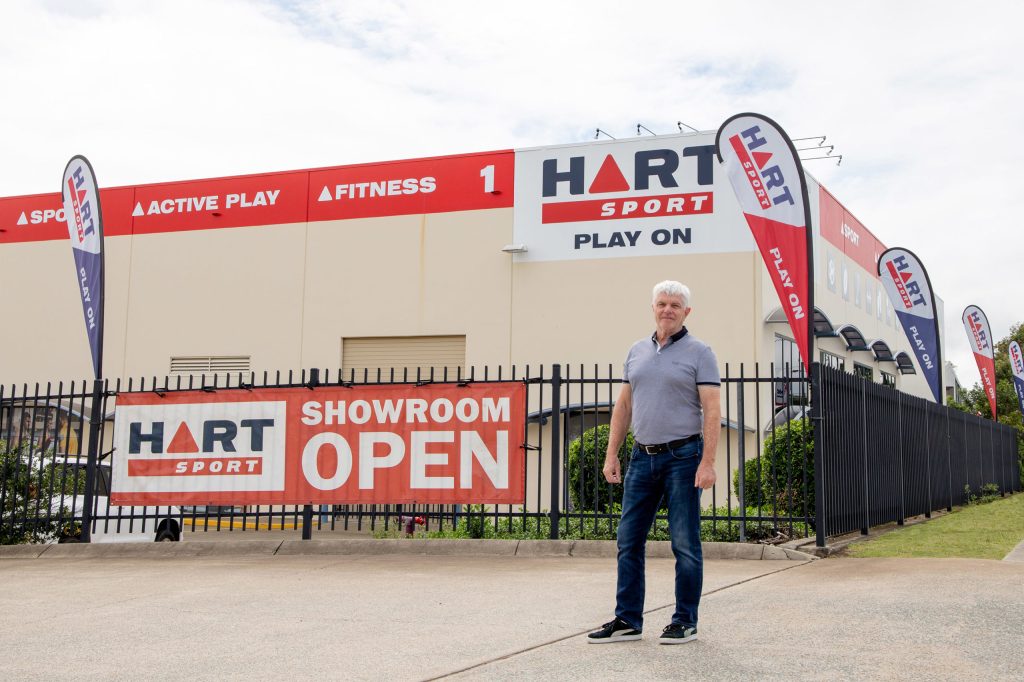
Greg Harten’s breakthrough came when he worked out how to stop schoolkids nicking the sports equipment.
He made it all bright yellow and black and branded it with the school’s name.
“We suddenly went from selling 500 basketballs a year to 5,000,” says Harten, who founded Brisbane-based sporting goods supplier HART Sport in 1992.
“In the first year we lost money, as you do, and in the second year we lost more money than in the first,” he says.
“And then, in the third year I was really happy because we didn’t lose quite as much money as in the second year.”
But then came his pilfer-proofing brainwave and the company has never looked backed.
“Turnover-wise, we’ve grown every year for 27 years,” Harten says.
The company operates from an 8500 sqm facility at Aspley and sells more than 3500 sports, fitness and active-play products to schools, clubs, fitness centres, government agencies and the general public in Australia and 40 other countries.
It provides equipment for more than 20 sports – from archery to water polo – and for every fitness category – from Pilates and yoga to weight training.
Its active-play products range from bean bags and hula hoops to 50 cm-long rubber chickens, which squeak when squeezed and can be found in the juggling category of Hart Sport’s 456-page 2021 buyer’s guide.
The buyer’s guide, which the company produces in-house — many of the models are staff members — is the secret to HART Sport’s success.
Harten came up with the idea while he was working as a tennis coach in Germany, where he spent 13 years after setting off to see the world once he’d completed a University of Queensland commerce degree in the late 1970s.
You might like


“I was a bit of a tennis player but I soon realised that I’d make more money out of coaching than playing,” he says.
In those days in Australia selling sports equipment to schools and sports clubs and institutions was no-frills business, according to Harten.
“It was basically done through price lists that were sent out like a racing guide with a series of names and numbers,” he says.
They did it differently in Germany.
“Over there, I’d noticed that people actually put out catalogues, which had photos and explanations and a bit on how to use the products.”
Harten decided to do the same thing when he returned to Brisbane at the beginning of the 1990s.
“That’s all I did. I put together a catalogue and sent it out to schools around Queensland.”
In the early days, HART Sport was like any other sports store, a middleman sourcing equipment and selling it on to customers.
“But we soon recognised there were a lot of flaws in that system, in that you’re not in charge of your own pricing or your own supply line or product range,” he says
“And so, we started to convert the more popular lines into our own products and then we started selling our own brands.”
Today, everything HART Sport sells is designed in-house and carries the company brand – even the juggling-friendly rubber chickens.
Most of its lines are manufactured offshore, mainly in China, or India or Pakistan, depending on the sport.
But the company also makes more than 700 foam and vinyl products at its Aspley facility, such as gym mats, rubber flooring and goal post pads.
“It all has to be made to a certain standard and you don’t want anyone being injured. The only way you can guarantee that is to make it ourselves,” Harten says.
The catalogue idea has been so successful, the company has never had a sales representative.
And that, according to Harten, is because what the company sells is functional.
“It’s stuff people need. It’s not highly packaged stuff where it’s just sold because the packaging’s so good.
“It’s stuff that elite teams can use and stuff that mums and dads can buy for their four-year-olds or their 12-year-olds.”
Stay informed, daily
Harten says the company has used Austrade in the past to find export markets but much of its international growth, particularly in Asia, was driven by expat teachers looking for a reliable supply of sports gear for their schools.
HART Sport’s name is now sufficiently well-known internationally it has made sales in countries where it has never marketed.
“There’s an organisation in Mexico that buys our early childhood stuff, but we’ve never marketed there and have never been there,” Harten says.
“I’ve got no idea how they found us.”
This time last year, Harten, like every other business owner in the country, was worried about the impact of COVID-19.
“We were certainly concerned because we sell to 10,000 schools and, state by state they started shutting down the schools,” he says.
“And then the grassroots sporting clubs started shutting down.
“But then, they shut down the gyms, which was the greatest godsend for us you could possibly imagine.”
That plus the desperation of parents with children suddenly stuck at home, which meant “every bit of equipment we had sold out within a few weeks.”
Following a brief slump in April and May while shelves were restocked, every month since June has been a record Harten says.
And still popular are Hart Sport’s yellow and black school-labelled range of sports gear – from footballs to hockey stick and tennis racquets.
“Schools still buy this stuff because they can look out across the field and know exactly what’s theirs and the kids can’t knock it off because if they take it home, it’s pretty obvious,” Harten says.
HART Sport is definitely a fine example of how to turn a good idea – catalogues for selling sports gear – into corporate success and how to convert a problem – light-fingered school kids – into a market opportunity.
But for someone who’s built a good idea into a solidly successful business, which employs 70 people in its Brisbane facility and has a branch in Auckland and more than 10,000 customers here and abroad, Harten is remarkably modest.
This is how he summed up his his telling of the company’s history during my recent interview with him at HART Sport’s Aspley office:
“Well, that’s where we’ve come from. We don’t make a big fuss of things.”
And that, you suspect, is the real secret to HART Sport’s success over the past three decades.
Want to see more stories from InDaily Qld in your Google search results?
- Click here to set InDaily Qld as a preferred source.
- Tick the box next to "InDaily Qld". That's it.



