Not for the first time, Scott Morrison finds himself on wrong side of strong women
Prime Minister Scott Morrison is battling to rescue his tattered image in the eyes of Australian women – but he doesn’t seem to be learning from past experience, writes Michelle Grattan
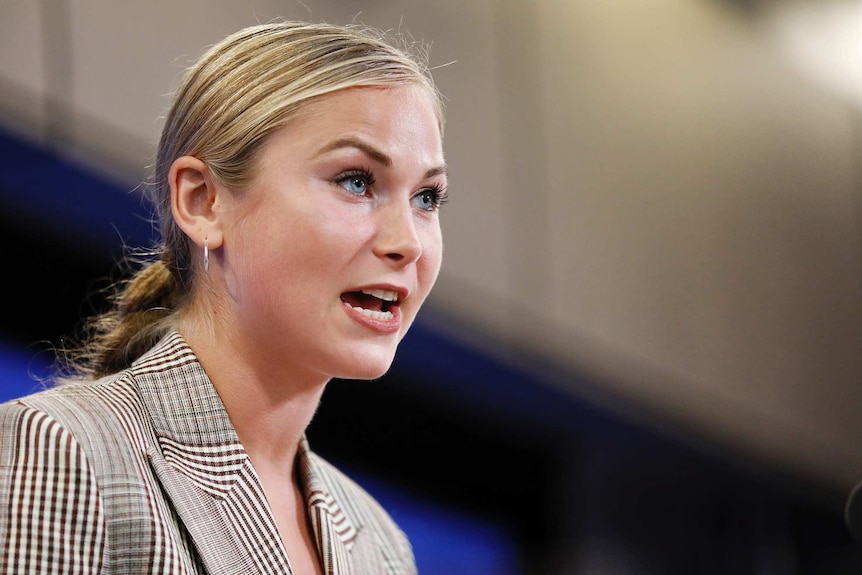
Scott Morrison is inclined to underestimate tough women.
He’s done this in the past, to his detriment. In 2006, when he was managing director of Tourism Australia, Morrison was sacked after falling out with the board and federal Liberal tourism minister, Fran Bailey.
Years later, in 2018, the Australian Financial Review quoted Tim Fischer, who’d chaired Tourism Australia at the time, saying “a lot of us could see it coming as relations between Scott and Fran Bailey had deteriorated over a range of issues. But Scott didn’t seem to see it.”
Morrison was close to then prime minister John Howard and he thought – erroneously – Howard would step in and save him from Bailey. But Howard supported his minister.
Fast forward to 2021, and Morrison’s grappling with a broad “women’s problem”. And women playing hardball are all around the place.
Take just two current examples, Christine Holgate and Grace Tame.
In a submission to a Senate inquiry released this week Holgate, former Australia Post CEO, has launched a comprehensive counterattack to her being effectively forced out of her job last year, after a ferocious prime ministerial attack.
On a very different front Tame, the young and feisty Australian of the Year, has targeted Morrison’s choice of Amanda Stoker to become the new assistant minister for women.
Morrison in October excoriated Holgate over her rewarding four employees with Cartier watches (worth an average of $5000) for landing a lucrative deal with banks, which sustained Post’s network of franchises around the country.
You might like


Immediately after Holgate had told a Senate committee about the watches, a furious Morrison let loose in the parliament. Declaring the action disgraceful, he said: “The chief executive has been instructed to stand aside and, if she doesn’t wish to do that, she can go.”
A devastated Holgate, regarded as a high-performing CEO, soon left her position.
A later inquiry (which the government initially declined to release) found no dishonesty or intentional misuse of Post’s funds, although it did find the purchase of the watches was inconsistent with the legislative obligation imposed on Post.
The controversy has now resurfaced with a Senate inquiry, instigated by Pauline Hanson, at which Holgate will appear next week.
Holgate argues in her submission the watches’ purchase was “legal, within Australia Post’s policies, within my own signing authority limits, approved by the previous Chairman, expensed appropriately, signed off by auditors and the [chief financial officer]”.
While Holgate in her submission focuses her ire on Post’s chairman, Lucio Di Bartolomeo, rather than on Morrison, the affair goes directly to the PM’s original reaction, which blackened her reputation.
Regardless of whether Post, as a government business, should have used watches as rewards, Morrison’s outburst was extreme and ill judged.
It led to a highly competent chief of a government business being publicly trashed and unnecessarily sacrificed, over not very much.
Holgate – who attracted sympathy from many CEOs and support among Australia Post small businesses – has yet to be replaced, a long and expensive process.
Morrison obviously thought the name “Cartier” would resonate (negatively) with his “quiet Australians”. If the employees had each been given cash bonuses of $5000 would he have reacted in the same way? The answer seems clear.
A harder question is, if the CEO had been male, would the PM’s temper tantrum have been as unrestrained?
Impossible to say, of course. But many people, especially women in this current climate of heightened sensitivity, would believe he’d have been more measured.
Stay informed, daily
Grace Tame – whose passionate words when awarded Australian of the Year were an influence on Brittany Higgins to go public with her rape allegation – is potentially an ongoing thorn in the side of a PM trying to assure women he “gets it”.
She’s a strong woman who finds herself, suddenly and unexpectedly, with a megaphone and she will use it all year.
In nominating Stoker, who is socially conservative and can be combative, as assistant minister for women, Morrison was inviting trouble.
Apart from dealing with the problems posed by Christian Porter and Linda Reynolds, the PM’s reshuffle was an effort to improve his and his government’s credentials on women’s issues.
It promoted female ministers and inserted references to “women” in various ministerial titles.
Yet he put Stoker into a position that would inevitably spark an adverse reaction among some women’s advocates.
Tame claimed Stoker had “supported a fake rape crisis tour aimed at falsifying all counts of sexual abuse on campuses across the nation”.
She said Stoker had also “supported” men’s rights advocate Bettina Arndt “who gave a platform [in an interview] to the pedophile who abused me”.
Stoker returned fire, defending her record promoting justice for women, and saying, “I did not attend Ms Arndt’s campus tour. I raised it in Senate estimates to highlight the universities’ inconsistent approaches to free speech and deplatforming.”
This week she dismissed Tame’s claims about falsifying accounts of abuse on campuses as “utter nonsense”.
Leaving aside the nitty gritty of their dispute, in the circumstances Morrison made a provocative choice, when he could have allocated the post to a less controversial frontbencher.
On Thursday Morrison and his new attorney-general Michaelia Cash unveiled the government’s full response to the Sex Discrimination Commissioner’s Respect@Work report.
The measures will strengthen protection for people in workplaces against sexual harrassment and remove the exemption from the sex discrimination legislation that members of parliament and judges now enjoy – although Morrison could not say how this would be applied in relation to MPs.
On Wednesday the government announced a two-day National Women’s Safety Summit to be held in late July.
The budget will have the stamp “women” on parts of it.
But the Prime Minister is not keen on the call, put forward for Friday’s national cabinet by Queensland premier Annastacia Palaszczuk, for a summit to address the “economic and social inequality facing Australian women”.
Palaszczuk, seizing the moment, wants national cabinet to host such a summit, which would have state and territory and stakeholder representatives. It would canvass issues including the pay and superannuation gender gaps and affordable child care.
“It’s the perfect time to have it,” she says. “Everyone is having conversations – in workplaces, around kitchen tables, on social media.”
A combination of such a broad agenda and so many strong women would make that a formidable political challenge for Morrison.
Want to see more stories from InDaily Qld in your Google search results?
- Click here to set InDaily Qld as a preferred source.
- Tick the box next to "InDaily Qld". That's it.



