Boning up on history, Griffith unearths insights into ancestors
Griffith University research into ancient bone artefacts and boomerangs used as daily tools in Australian Aboriginal culture has unearthed incredible insights about our ancestors.
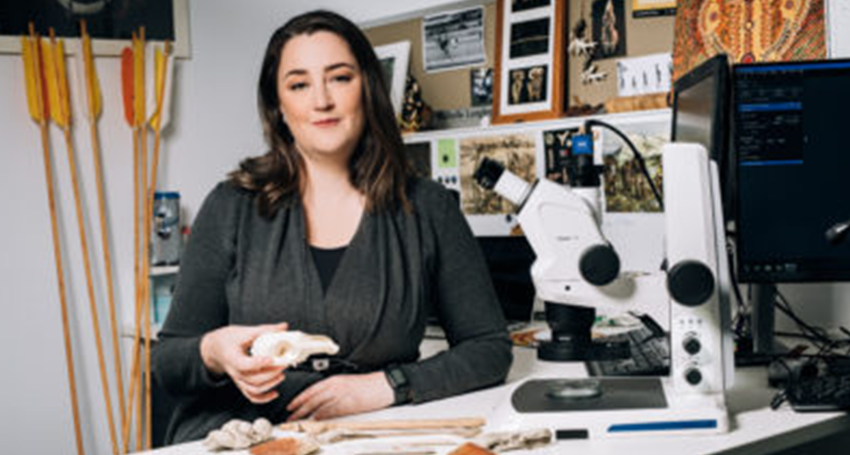
Two separate research projects, carried out by Griffith’s Australian Research Centre for Human Evolution (ARCHE) have released findings which indicate the wide variety of uses for bone tools and boomerangs in ancient times.
PhD candidate Eva Martellotta worked with ARCHE’s Dr Michelle Langley (also Forensics & Archaeology, School of Environment and Science), Professor Adam Brumm and Dr Jayne Wilkins to examine microscopic marks on the surface of 100 boomerangs from across each state and territory curated by the Australian Museum in Sydney

Using a traceological method the researchers were able to more clearly see what tasks the boomerangs were used for by Aboriginal Australians in the past.
“Our findings constitute the first traceological identification of hardwood boomerangs being used for shaping stone tools in various Aboriginal Australian contexts, but this is only the tip of the iceberg,” Martellotta said.
“Ethnographic evidence show that boomerangs were also used for making fire, for playing music, and as digging sticks.
You might like


“This research emphasises the multipurpose nature of daily tools – like boomerangs – in Aboriginal culture.
“Not all boomerangs come back. Most are used for hunting and fighting purposes, whereas the returning ones are often children’s toys or used for games and learning purposes,”
In another project, Dr Michelle Langley worked with Professor Jane Balme from The University of Western Australia and Professor Sue O’Connor from The Australian National University to identify bone artefacts found in a famous Kimberley cave site in Western Australia.
Their work, published in the International Journal of Osteoarchaeology, reappraised the age of the artefacts as being more than 35,000 years old, making them among the oldest bone tools found in Australia.
“These tools indicate that bone tools have been around for a very long time in the Indigenous Australian toolkit; we once thought that bone tools were not so important in the north of Australia and were only brought into the toolkit relatively recently,” Langley said.
“These tools show that wasn’t the case – they were always made and used, we just hadn’t found them because they haven’t been surviving long time periods in the hostile preservation conditions of northern Australia.”
Stay informed, daily
Langley said the bone artefacts were of different forms with different traces of use, evidence of a variety of uses for the bone tools in the region in the deep past.
“They were used for activities which typically do not survive archaeologically,” she said.
“One indicates plant or skin working (making baskets or working skins) while another appears to have been used in digging up or working resin. Resin was used to glue together tool parts and to make hand holds for tools.”

“These tools show the importance of organic materials in the early technologies of First Nations people, and they provide a window into a greater diversity of activities undertaken by people than are revealed by stone artefacts alone,” Balme added.
“We are grateful for the generosity of the Mimbi Community who gave us the opportunity to study this site.”
Four of the bone artefacts were found in layers dating from between 35,000 and 46,000 years ago, making them some of the oldest bone tools in Australia.
Previously, the oldest bone artefact from Carpenter’s Gap 1 in the Kimberley was found to be <46,000 years old.
Griffith researchers within ARCHE conduct some of the world’s most comprehensive analyses of human evolution, fostering research excellence through multidisciplinary projects that bring together leading scholars and institutions in the field of human evolution from around the world.
Want to see more stories from InDaily Qld in your Google search results?
- Click here to set InDaily Qld as a preferred source.
- Tick the box next to "InDaily Qld". That's it.



