Adani accuses banks of acting against national interest
Adani has claimed the nation’s banks and insurance companies were boycotting the industry and should be regulated with a national interest test as well as be prohibited from targeting any industry.
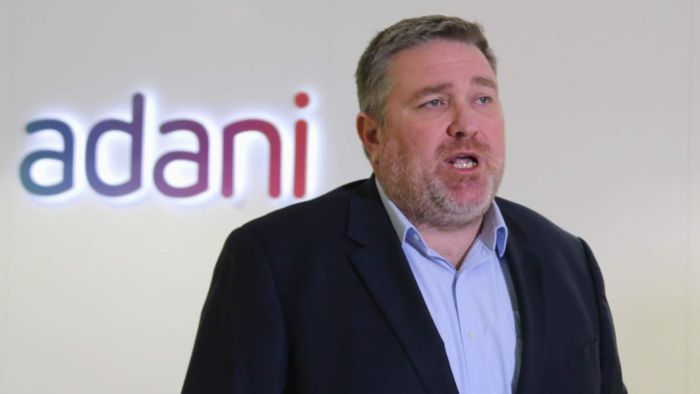
Giving evidence to a Federal parliamentary inquiry led by Queensland MP George Christensen, Adani Australia chief executive Lucas Dow accused the banks of hypocrisy for refusing to deal with coal companies while also providing home loans and insurance to employees of the coal sector.
Dow said while the Carmichael coal project was fully funded and financed the banks had refused to deal with the company over its Rugby Run solar farm at Moranbah and its Abbot Point port.
“We have Australian banks that have flat out said they would not fund Adani projects simply because of who we are and that is inclusive of renewable projects,” Dow said.
“The issue is we don’t know (why). What we are seeking is transparency from the banks. What we are seeing is the banks flat-out abandoning the resource sector because they are either too lazy or not willing to apply the intellectual capacity to manage the risk appropriately and safeguard Australian jobs.
“In short they have blacklisted the industry or its participants.
“If you are damaging the Australian economy how could you reasonably expect that is an action that is in the best interest of the nation?
“If the regulators can regulate so that companies can assess climate risk surely they can regulate so that we can assess national interest.
You might like

“What we are talking about is putting in tests so that Australians are not disadvantaged.”
Dow said there had been no risk assessment by the banks and he cited the company’s Abbott Point coal where Australian banks won’t participate in funding because of its role in servicing the Carmichael mine.
“There’ no risk assessment in that. That is nothing more than them saying they don’t want the activists pitching up at their front door,” he said.
“The issue has become, in a sense, a contagion. Irrespective of the project if you have Carmichael in your portfolio you can’t do any good anywhere else.
“We approached Australian banks in relation to finance for that facility (Rugby Run solar farm) and they said: ‘We can’t help you’.”
He admitted the banks never gave a reason for their refusal but there was no suggestion that it was a credit risk.
Other evidence to the hearing came from Queensland Resources Council chief executive Ian Macfarlane who said a survey conducted by his organisation indicated that about 3300 jobs were at risk in central Queensland over the next five years because of the inability of companies to access finance and insurance.
He said member organisations said there had been a 50 per cent to 85 per cent increase in banking costs and for about one third of those surveyed there was a risk of going out of business in five years.
Stay informed, daily
He said for many costs had increased up to 120 per cent in two years.
He said banks and insurance companies were acting beyond the science climate change and beyond any government legislation.
David Hartigan from the Mackay based Field Engineers told the inquiry that his company had been forced to borrow to pay insurance costs which was now 18 times more than it was six years ago.
“It’s our single biggest cost other than wages,” Hartigan said.
Want to see more stories from InDaily Qld in your Google search results?
- Click here to set InDaily Qld as a preferred source.
- Tick the box next to "InDaily Qld". That's it.