Gold Coast holiday makers hold their nerve amid concerns over new Covid variant
Gold Coast tourism bosses believe the holiday tourism boom is still coming in the face of the rogue new Omicron Covid-19 variant.
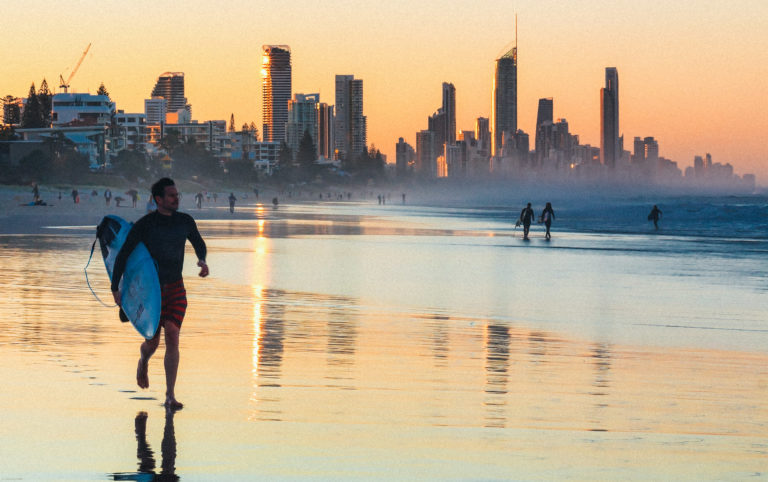
The nation’s tourism capital currently has occupancy locked in at around 70 per cent over the Christmas break and is on track for record-breaking flight arrivals, but remains on tenterhooks as authorities scramble to react to the emergence of the new strain.
However, Destination Gold Coast chief Patricia O’Callaghan said unlike in previous outbreaks, there had been no mass cancellations by Gold Coast holiday makers, with visitors holding their nerve that they would get to travel to Queensland despite the new cases.
“I think we know that visitors and potential travellers very much are getting used to living within a pandemic,” O’Callaghan said.
“We are seeing changes in behaviours – we are seeing people book closer to their day of travel, we are seeing them hold on to bookings when there are changes in the environment.
“At the moment we are not hearing mass cancellations. Everyone is holding on to their bookings. It’s welcome news. How we react to this variant will determine what our industry looks like moving into the future.”
Queensland Airports CEO Chris Mills said the number of flights booked to the Gold Coast remained above pre-Covid levels.
With potentially record-breaking number of arrivals scheduled over Christmas holding firm, Mills said the airport “didn’t have time to worry about the Omicron variant.”
O’Callaghan said bookings were continuing to build daily.
You might like


“What we know is that there is very, very strong pent-up demand across Australia to come here, particularly those interstate visitors, Sydney and Melbourne, who are regular visitors to the Gold Coast are very much missing us,” she said.
“They are searching for us, they are looking at what accommodation and tourism experiences they want to do. With air capacity loaded, they are converting that to real travel.
“We know that it will potentially be a real boom period for our industry and one that we’ve waited for for two years.”
The Australian Government has called for calm in the face of the new variant, with the national security committee meeting on Monday afternoon and National Cabinet scheduled to meet Tuesday.
Meanwhile, there are concerns that responses to the new threat may blunt Australia’s economic recovery.
“Omicron … may pose some setback to the strong post-lockdown recovery under way,” RBC Capital Markets chief economist Su-Lin Ong said.
“Given the Delta experience, we would expect policy makers to assume the worst, move quickly, and take an overly cautious approach, which appears to be emerging.”
But Business Council of Australia chief executive Jennifer Westacott warned Australian governments against over-reacting to the new strain.
“The worst thing we can do is panic,” Ms Westacott told Melbourne’s 3AW radio on Monday.
“The worst thing we can do is stall the economic momentum, particularly for small business.”
Stay informed, daily
She said small business has just been through hell with the economy “stopping and starting” due to lockdowns.
Westacott said Australia has had enough experience handling the virus without needing state-wide lockdowns and border closures, and a more uniform, targeted approach should be taken if needed.
“And, for God’s sake, can we have the same rules across each state?” she added.
Infectious diseases expert Peter Collignon said fear of the new variant was “out of proportion to the data at the moment”.
The national accounts for the September quarter due on Wednesday will show the impact on the economy of having NSW, Victoria and the ACT in lockdown fighting the Delta variant.
At this stage economists are predicting a 2.5 per cent economic contraction, although figures released on Monday suggest there is some downside risk to this outcome.
Japan announced it will suspend entry of all foreign visitors from around the world from Tuesday.
The spread of Omicron has already pushed some states to bring in extra restrictions on overseas arrivals. Some states including West Australia have also tightened rules for arrivals from other states where there has been a relaxation or reopening of international borders.
As yet, Queensland has made no changes to its border reopening plans.
Deputy Premier Steven Miles said health experts were watching the new variant to see if current restrictions in the state were adequate.
He said the state remains on track to scrap quarantine for vaccinated domestic arrivals who test negative once 80 per cent of eligible Queenslanders are fully vaccinated.
However, under federal guidelines, all arrivals from nine African countries – South Africa, Namibia, Zimbabwe, Botswana, Lesotho, Eswatini, Seychelles, Malawi and Mozambique – must undergo 14 days quarantine.
The Omicron variant has been detected in Australia, Belgium, Botswana, Britain, Denmark, Germany, Hong Kong, Israel, Italy, the Netherlands, France, Canada and South Africa.
-with AAP
Want to see more stories from InDaily Qld in your Google search results?
- Click here to set InDaily Qld as a preferred source.
- Tick the box next to "InDaily Qld". That's it.