Meet the robot fish set to frighten the life out of rogue species
Australian researchers say invasive species could be controlled by scaring them away with robots.
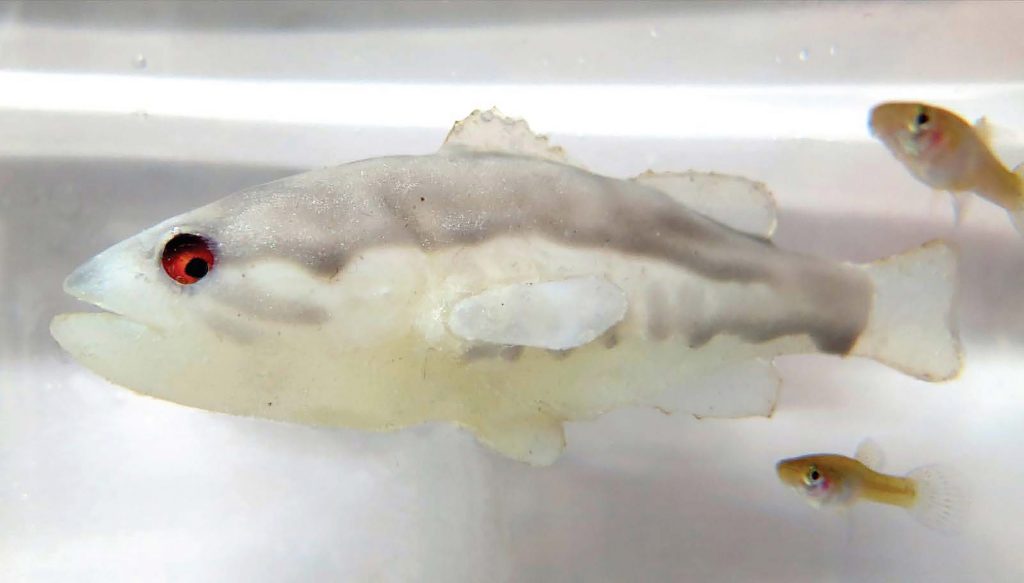
A team from the University of Western Australia built a robot fish in 2018 which they’ve now used to scare away one of the world’s most invasive species, the mosquitofish, which they describe as “one of the most problematic animals on the planet”.
In a study published on Friday in the journal iScience, researchers reveal how fear altered the invasive fish’s behaviour, physiology and fertility, effectively “scaring it to death”.
The international team of biologists and engineers from Australia, the US and Italy, used the decoy to mimic its natural predator – the largemouth bass by simulating its movements.
Gambusia, known as mosquitofish, was originally introduced into Australia about 100 years ago to combat mosquitoes. It is now considered one of Australia’s biggest freshwater threats.
Now there are millions of the tiny fish threatening Australia’s native fish population as well as frogs, as it chews off the tails of freshwater fishes and tadpoles, and eats fish and frog eggs.
You might like


Report author Giovanni Polverino, a behavioural ecologist at the University of Western Australia, says the mosquitofish is particularly damaging to Australia’s natural ecosystem.
“We made their worst nightmare become real, a robot that scares the mosquitofish but not the other animals around it,” he told AAP.
“Instead of killing them one by one, we’re presenting an approach that can inform better strategies to control this global pest,” said Dr Polverino.
Invasive species cost Australian agriculture and the environment around $25 billion every year according to the Centre for Invasive Species Solutions.
Stay informed, daily
“Gambusia endangers a range of threatened species, including the green and golden bell frog,” the centre’s CEO Andreas Glanznig says.
“Given the predator is such a key threat, any effective technology that can reduce their impact is welcomed.”
And Dr Polverino says the concept could be applied more widely.
“Every animal on the planet is affected by predators … we have now applied this idea into an aquatic system where we have invasive species and endangered species but the idea could be applied on a terrestrial system,” he told AAP.
The robot “precisely targets the bad guys” without threatening the native species.
Dr Polverino explained that the robot was built “to copy the ancestral predator” of Gambusia, which has American origins.
“We made their nightmare visibly real, but without scaring the Australian species who haven’t encountered the predator before, so they’re not afraid.”
Peter Johnson, from the the Queensland branch of the Australian New Guinea Fishers Association, says the mosquitofish problem is a failure on the scale of the cane toad.
Getting rid of mosquitofish would allow native species to return and lead to healthier aquatic ecosystems like freshwater fisheries, he said.
“Gambusia are quite aggressive, they’ll attack the fish directly as well,” Mr Johnson said, such as small bodied native species like rainbow fish.
Want to see more stories from InDaily Qld in your Google search results?
- Click here to set InDaily Qld as a preferred source.
- Tick the box next to "InDaily Qld". That's it.



