As he ramps up the hysteria over China, has Morrison’s ship finally come in?
It might not be earning him any votes on university campuses, but Scott Morrison is finally gaining some traction among the “quiet Australians”, writes Dennis Atkins.
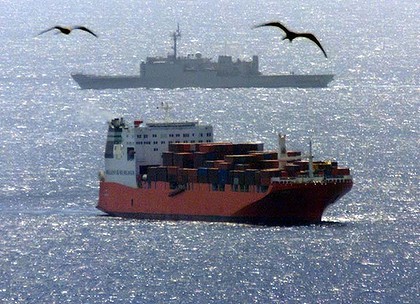
There was no chance of Osama bin Laden turning up at a playgroup on Bribie Island in October, 2001.
This didn’t stop people from being afraid of such a possibility, as the Labor Party discovered in the roiling weeks of Australia’s last full blown nation security election.
Already on alert, and definitely trending alarmed, people had their anxiety levels dialed up when the MV Tampa bounced on the ocean currents to Australia’s north west with 433 asylum seeking refugees mostly from the Hazaras ethnic minority in Afghanistan.
Then Prime Minister John Howard, steering a comeback after a topsy turvy year electorally, was cranking national security up as far as he could, driving a wedge into Labor ranks and challenging the asylum rights of those wretched souls all the way to the High Court.
His campaign was hit out of the park when that bin Laden guy orchestrated the biggest attack on the US homeland in 60 years, bringing down the World Trade Centre towers in New York, smashing a hole into the Pentagon defence HQ and scattering a plane load of innocents across a Pennsylvanian field after an aircraft aimed at the White House or Congress was pushed down to earth by a few bravehearts.
During that campaign, the Labor Party’s then national secretary Geoff Walsh read with varying levels of despair the research reports from across the country.
One focus group in South East Queensland contained a small nugget from a woman on Bribie Island. She had a simple question for the moderator: “What are you going to do when Osama bin Laden turns up at my daughter’s kindy?”
You might like
It was brutally direct. Walsh knew Longman was going to be in the “probably too hard” column for the election, even though Labor had secured a 9 percent swing in 1998.
He soon moved it to the “no chance” column – a decision shown as spot on when the Liberals picked up the collapse in One Nation support and held onto the seat with a two point increase in the preferred vote.
It’s politically incorrect to use the language of the old political school but during any national security crisis, many non-tertiary educated, manual workers and their families swing to or stay with conservative parties.
They used to call it the “daddy party” trumps the “mummy party” theory of voter behaviour. In these non-binary times who knows what we should call it.
At the moment, Scott Morrison is in just as much trouble electorally as John Howard was two decades ago, which explains the cacophony around national security as the numéro du jour in national politics.
Morrison has taken the national security debate to Spinal Tap heights and kept it there for two weeks. He hasn’t allowed a zeptosecond to pass if any opportunity arises.
Here’s a few examples: Anthony Albanese says something positive about Paul Keating who wants a non-aggressive, long-game approach to China, making the Labor leader an enemy of the state.
Deputy Opposition leader Richard Marles went to Beijing years ago and didn’t call for Xi Xinping’s head on a spike, therefore he’s a Manchurain candidate.
Stay informed, daily
Labor front bench member Tanya Plibersek called Israel a “rogue state” during a heated debate on Iraq 20 years ago and is today a threat to world peace.
Morrison, his ministers and backbench cheer squad push along a fight with an understandably concerned national security First XI – from eminence grise and former everything Dennis Richardson to incumbent ASIO boss Mike Burgess – just so they can keep the spotlight on Labor.
The backdrop of the 80th anniversary of the bombing of Darwin is appropriated to keep the rhetoric flowing, as is a reckless laser game by Chinese military personnel towards a Royal Australian Air Force plane.
Morrison had a goal every bit as focussed as that laser rangefinder used by a Chinese naval vessel towards an Australian surveillance plane in the Torres Strait. He wanted Australians to adopt two linked thoughts about Albanese and national security: doubt and risk.
Morrison wants enough Australian voters to have doubts about Albanese on national security, whether it’s his ability or his commitment to the country’s interests.
The prime minister also wants voters to think handing the national security reins to Albanese at a time of global uncertainty and multi-level danger would be a risk too far.
It’s a simple equation and Morrison has demonstrated he’s not about to give up on it, as much as the elite commentators might urge him to back off.
Morrison might be clumsy, sometimes inept in tactical shifts and almost always inelegant in action and language. However, he’s not stupid.
He will keep doing what he’s doing if he’s told by the regular Liberal Party focus group reports that the “quiet Australians” share his views and answers.
The coincidence of an ongoing crisis in Ukraine – possibly the worst in Europe since the mid-1940s – and a belligerent China capable of just about anything will keep people’s anxiety levels very stressed for weeks.
Labor’s response is insipid and probably useless. They spent most of last week arguing over process – whether or not Morrison and his defence minister Peter Dutton had the right to attack the Opposition.
Americans like to say “politics ain’t bean bag” which is another way of highlighting the often nasty, not for the squeamish, contact nature of the contest.
Here, the better analogy is the school yard fight. You don’t win one by running to the teacher to say the kid who hit you was mean. You win by retaliating with an attack that’s harder and more sustained.
Labor showed none of that fighting spirit this past week. Morrison didn’t have a great first two weeks of Parliament (he’s really only got one more to go) but he finished in better shape than he began.
Want to see more stories from InDailyQLD in your Google search results?
- Click here to set InDailyQLD as a preferred source.
- Tick the box next to "InDailyQLD". That's it.