Memo Albo: Just when you least expect it, expect it
Opinion polls this week would have given the Opposition leader Anthony Albanese cheer so close to an election his party is desperate to win. What could possibly go wrong now? Plenty, says Michelle Grattan.
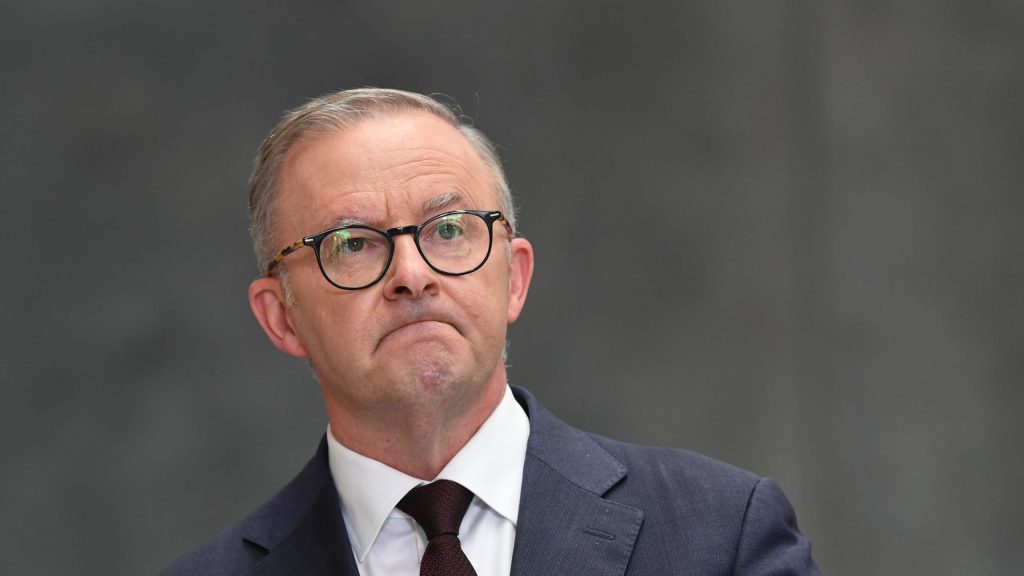
Polls this week were once again music to Labor ears. Newspoll showed the opposition maintaining its strong election-winning margin. A poll in selected Western Australian seats had the Morrison government on the nose.
Polls, as everyone stresses, aren’t predictive – they register the mood of the moment. Nevertheless, and despite their unreliability in the last election, politicians and media take a lot of notice of them, and for Anthony Albanese their story is very positive.
So what could possibly go wrong on the opposition leader’s path to The Lodge? Plenty, as Labor knows, reinforced by that 2019 experience of false expectations. When voters really started concentrating during that campaign, they soured on the opposition.
Viewed from Labor’s campaign bunker, the weeks between now and election day in May are very high risk for Albanese, littered with both anticipated and unforeseeable hurdles.
There was a lesson this week in how damaging things can come out of the blue, when Albanese was confronted with (contested) allegations, reported in The Australian, that senior Labor women senators, including Penny Wong, had treated their colleague Kimberley Kitching badly.
While Kitching’s complaints had apparently circulated within Labor, it took her sudden death last week from a suspected heart attack for them to burst into the media.
The claims about Labor’s “mean girls” (the term the article said Kitching and her supporters used) were confronting when set against the background of a year’s debate about parliament house’s “toxic” culture.
Albanese and Labor generally sought to throw a blanket over the story, refusing to engage with it on the grounds of respect for Kitching. Scott Morrison tried to spur it along, saying these matters should be taken very seriously and addressed, and “I’ll leave that to the leader of the Labor Party”.
You might like
The so-called “mean girls” story will blow over, but it’s a reminder that in a campaign context (which is where we are, although the election hasn’t yet been called) the unexpected, in whatever form, often deals itself in.
An unknown of the coming weeks is how Albanese will perform under the intense hour-by-hour scrutiny that will build every day. “No one has seen Albanese under extreme pressure,” says one Labor man. “That’s the hinge-point around the campaign.”
Albanese is not, by nature, quite the relaxed character he might seem. The spring is coiled. This is not necessarily a criticism, but something to be managed. With the Liberals targeting him personally and mercilessly, his ability to perform without serious mistakes in a high political temperature will be pushed to the limit.
In a campaign, a small slip or awkward moment can quickly becomes negative news, as Bill Shorten found when a Queensland man challenged him about tax relief for higher-income workers. The media played the exchange repeatedly.
Campaigns “stress test” policies. Shorten’s 2019 climate policy did not contain enough detail to be campaign-resilient. A pesky journalist’s persistent questioning at one news conference had Shorten on the spot and showing the strain.
Spectacularly, in 1987 the Howard opposition’s tax policy had a double-counting error – the mistake dogged the Liberals’ campaign.
Campaigns are two-horse races: if one horse is lame (Malcolm Turnbull in 2016) it matters.
Two scheduled events will be significant in whether Albanese holds his advantage, or the government claws back ground: Tuesday week’s budget and the opposition leader’s budget reply two days later.
For a government in what seem dire straits, the budget is its chance to direct the voters’ attention to the economy, its preferred and stronger ground, and to offer some inducements.
But it’s become a balancing act for Morrison and Treasurer Josh Frydenberg. They’ve flagged the budget will address people’s concern about the rising cost of living, but they can’t afford to look profligate, given addressing the high level of debt must also be a priority.
Stay informed, daily
Albanese will use his reply to counter the budget and announce some big-bang policy. His delivery will need to be well-pitched and the policy attention-grabbing and credible.
In the next few weeks Albanese, who’s still to define himself in the public’s consciousness, must convince people he’s a safe pair of hands on the economy. That might be more challenging than the issue of national security, on which the government’s efforts to damage him seem so far to have missed their mark.
While Labor is wary of being sucked in by the polls, the government is fearful of their consistent message.
Morrison finally got to Western Australia this week, coinciding with polling published in the West Australian newspaper showing several Liberal seats at high risk.
The poll, by Utting Research, indicated Labor was travelling strongly in Pearce (the seat Christian Porter is leaving) and Swan, and ahead in Hasluck. In Tangney, held by Special Minister of State Ben Morton, a close confidant of Morrison, the numbers were knife-edge.
Morrison adopted a novel campaign strategy: a bromance with Labor premier Mark McGowan, who was returned last year in a stunning victory that all but wiped out the state parliamentary Liberal Party.
According to the prime minister’s “spin” on their partnership, the federal government’s joining Clive Palmer’s case against WA over its border closure should be seen as just part of the pandemic learning process. “The premier raised his concerns with me […] and we ultimately agreed with him”, and withdrew from the case, Morrison said.
The PM’s line to WA voters is that “federal Labor under Anthony Albanese is not the same as state Labor under Mark McGowan. There are two very different animals”. Regardless of who people vote for at the election, “Mark McGowan will be the premier the next day”.
When the two appeared together at a news conference, where new construction funds were announced, Morrison was effusive.
“I want to thank the premier for his partnership. It’s been a good partnership. It’s been an honest partnership. It’s been a candid partnership. Haven’t agreed on everything, but we’ve always been prepared to listen to each other and where […] I think I’ve had to change my view based on the premier’s representations, I certainly have.”
Appearing by himself later, McGowan reassured Labor he would be campaigning with and for Albanese.
Excluded by the closed border for so long, Morrison has been desperate to get to the west. But whether his physical presence and his largesse will erode those Labor leads is another matter.
In general, the federal Liberals in WA are a much-diminished bunch, in power and presence. They no longer have the sparkle of a Julie Bishop, or the strong dour presence of a Mathias Cormann. The star of Christian Porter burned brightly briefly, then fell to the ground spectacularly.
Michelle Grattan is professorial fellow at the University of Canberra. This article was originally published in The Conversation and is re-published here under Creative Commons licence.
Want to see more stories from InDaily Qld in your Google search results?
- Click here to set InDaily Qld as a preferred source.
- Tick the box next to "InDaily Qld". That's it.