Dying star among stunning images from new NASA telescope
NASA has unveiled a new batch of images from its new powerful space telescope, including a foamy blue and orange shot of a dying star.
The first image from the $A15 billion James Webb Space Telescope was released on Monday at the White House — a jumble of distant galaxies that went deeper into the cosmos than humanity has ever seen.
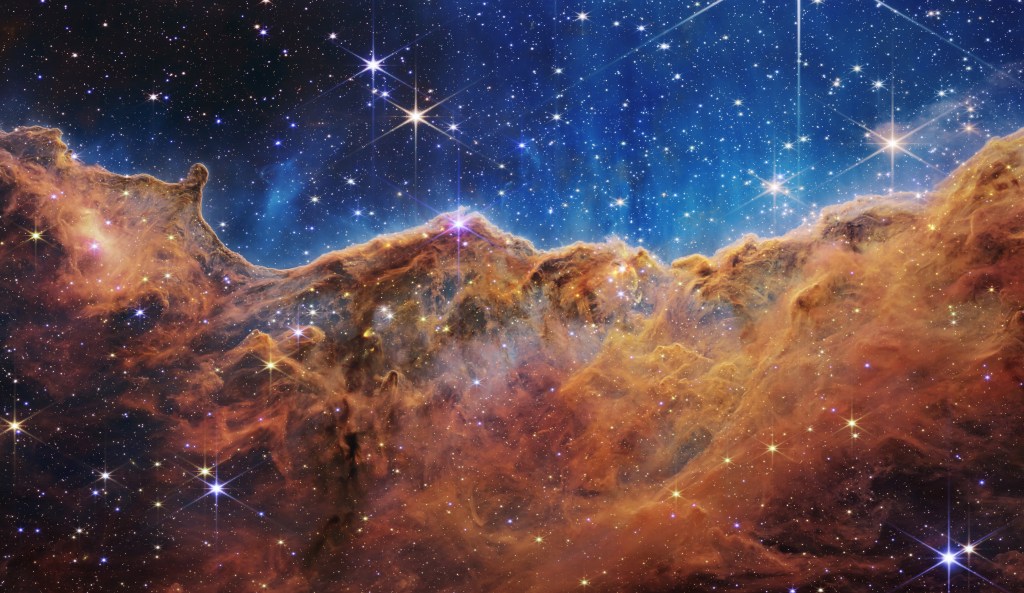
The four additional photos released Tuesday included more cosmic beauty shots.
With one exception, the latest images showed parts of the universe seen by other telescopes.
But Webb’s sheer power, distant location off Earth and use of the infrared light spectrum showed them in new light.
“Every image is a new discovery and each will give humanity a view of the humanity that we’ve never seen before,” NASA Administrator Bill Nelson said Tuesday, rhapsodising over images showing “the formation of stars, devouring black holes.”


Webb’s use of the infrared light spectrum allows the telescope to see through the cosmic dust and “see light from faraway light from the corners of the universe,” he said.
“We’ve really changed the understanding of our universe,” said European Space Agency director general Josef Aschbacher.
The European and Canadian space agencies joined NASA in building the powerful telescope.
The images released on Tuesday included the Southern Ring Nebula or “eight-burst’ which shows an expanding cloud of gas surrounding a dying star about 2500 lightyears away; Carina Nebula, one of the bright stellar nurseries in the sky, about 7600 lightyears away; five galaxies in a cosmic dance, 290 million lightyears away; and blueish giant planet called WASP-96b – it’s about the size of Saturn and is 1150 lightyears away.
A gas planet, it’s not a candidate for life elsewhere but a key target for astronomers.
Stay informed, daily
The images were released one-by-one at an event at NASA’s Goddard Space Center that included cheerleaders with pompoms the colour of the telescope’s golden mirrors.
The world’s biggest and most powerful space telescope rocketed away last December from French Guiana in South America. It reached its lookout point 1.6 million kilometres from Earth in January.
Then the lengthy process began to align the mirrors, get the infrared detectors cold enough to operate and calibrate the science instruments, all protected by a sunshade the size of a tennis court that keeps the telescope cool.
Webb is considered the successor to the highly successful, but ageing Hubble Space Telescope.
Want to see more stories from InDaily Qld in your Google search results?
- Click here to set InDaily Qld as a preferred source.
- Tick the box next to "InDaily Qld". That's it.



