Crash landing successful as spacecraft slams into asteroid
A NASA spacecraft with specialist guidance from Australian tracking systems has crashed into a deep space asteroid in a dress rehearsal for the day a killer rock slams into Earth.
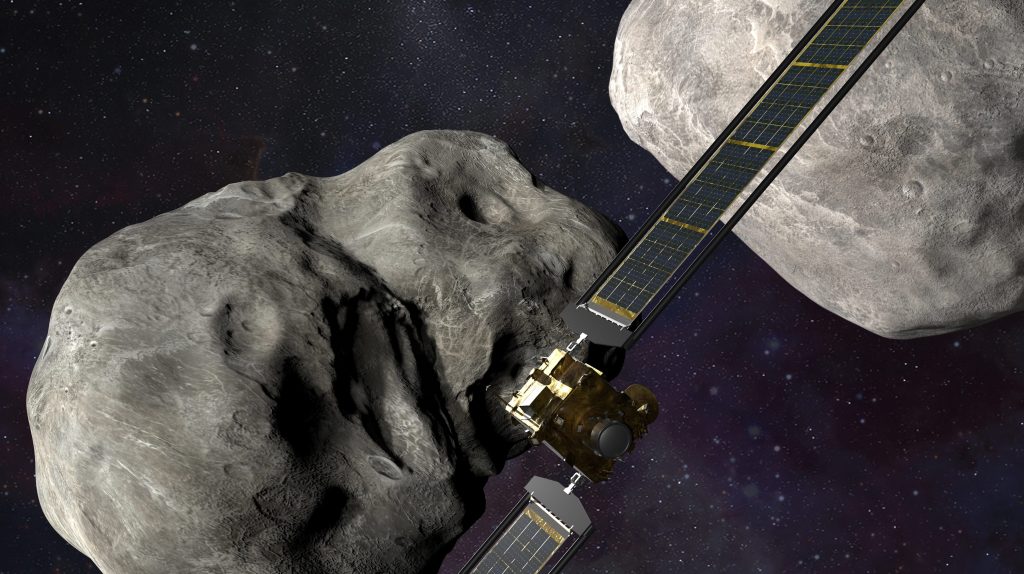
The multimillion-dollar rocket collided head-on with an asteroid the size of the Great Pyramid of Giza around 9.15am (AEST) on Tuesday, in what was the world’s first full-scale planetary defence test.
The 570-kilogram spacecraft named Dart and the small asteroid known as Dimorphos crashed into one another at high speed as part of NASA’s Double Asteroid Redirection Test mission.
The test is to determine if intentionally crashing a spacecraft into an asteroid is an effective way to change its course.
The NASA bunker broke out into cheers and applause as the test was deemed a success.
“We’ve been talking about the images we’re going to see … and I think they exceeded my expectations,” DART coordination lead Nancy Chabot told the NASA livestream on Tuesday.
“This was a really hard technology demonstration to hit a small asteroid we’ve never seen before and (we did) it in such spectacular fashion.”
You might like


Australian scientists were part of the international team working to hit the asteroid 11 million kilometres away from Earth.
The Canberra Deep Space Communication Complex received the final signals from the spacecraft as it approached and impacted Dimorphos.
It also captured images and data from a cubesat module, which had already separated from Dart.
“The team has been training for nearly two years for this mission,” Glen Nagle from the CSIRO NASA tracking station told AAP.
“They just did a spectacular job maintaining that contact right throughout, helping return spectacular images.
“I couldn’t be more proud of our team here at the CSIRO. They have made history.”
Stay informed, daily
The European Space Agency’s deep space tracking station in Western Australia also supported the mission.
During the final stages, its 35-metre antenna at New Norcia received data from the spacecraft that will be used by scientists to estimate the mass of the asteroid, surface type and impact site.
NASA administrator Bill Nelson commended the international team’s successful test.
“It’s going to teach us how one day to protect our own planet from an incoming asteroid,” he told the NASA livestream on Tuesday.
“I really look forward to learning all about what’s happening from the observatories, so they can tell us about the changes in this asteroid’s orb.”
While no known asteroid larger than 140 metres in size has a significant chance of hitting Earth for the next 100 years, it’s estimated only about 40 per cent have been identified to date.
In the coming weeks, the DART team will learn whether the collision interfered with the asteroid’s orbit.
“There’s still a lot of information for us to return for the scientists to then do further analysis,” Mr Nagel said.
“There are still weeks and months ahead of data to get back and probably years ahead for the mission scientists to be able to determine the results of today’s exciting events.”
Want to see more stories from InDaily Qld in your Google search results?
- Click here to set InDaily Qld as a preferred source.
- Tick the box next to "InDaily Qld". That's it.



