Tax cuts: Albo might have to pay a big price for being the small target man
Anthony Albanese and his Treasurer, Jim Chalmers, are floating the political balloon of tinkering with the so-called Stage 3 income tax cuts. It’s a high risk game, writes Michelle Grattan.
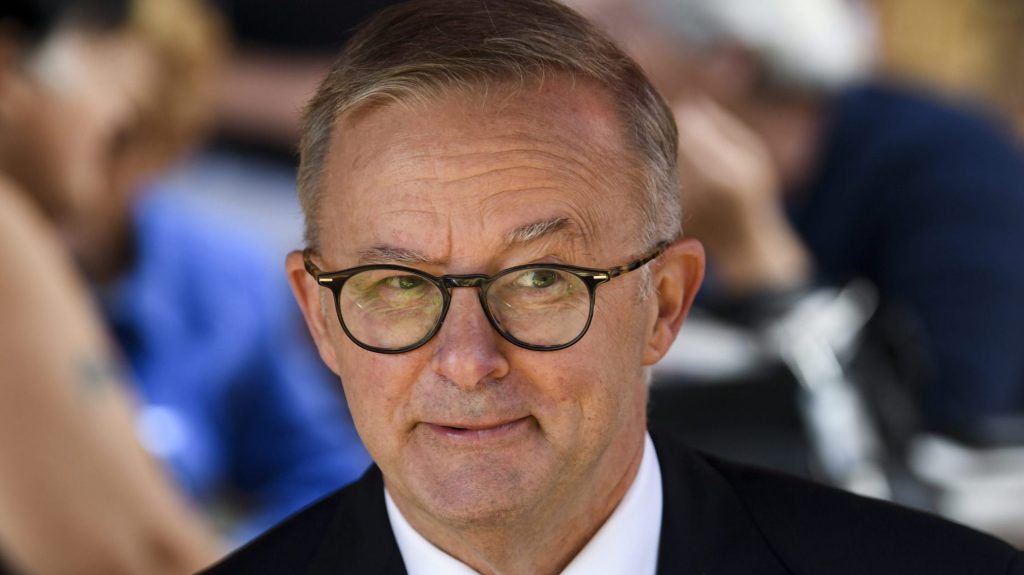
When Scott Morrison was treasurer he flew the kite for an increase in the GST. The debate ran a while, before then prime minister Malcolm Turnbull shut it down. It was all too hard.
Now we have Jim Chalmers with a kite up, although he’s not “freelancing” as much as the wilful Morrison did.
Anthony Albanese is sanctioning Chalmers testing the mood for recalibrating the tax cuts.
Asked on Thursday whether he’d had Albanese’s permission to “float that balloon” on changing Stage 3, Chalmers said, “I don’t need permission to point out that every budget we hand down, including the one in three weeks’ time, will put a premium on responsible economic management”.
At no point during Thursday’s news conference did Chalmers discourage the conclusion that the shape of Stage 3 is up for reconsideration. “It’s not a big surprise to me that on an issue as big as this, there’ll be a range of views,” he said
Stage 3, the last part of the Coalition’s tax package, is tilted towards those on higher incomes.
People on incomes between $45.000 and $200,000 would pay a marginal rate of 30 per cent, with the top 45 per cent rate cutting in at $200,000, rather than the present $180,000. The cost would be more than $240 billion over the first decade.
Only weeks ago Chalmers was insisting this was not the time to discuss Stage 3, which doesn’t start until mid-2024. Now he’s deliberately letting the talk run, highlighting the increasingly uncertain international economic outlook.
Despite repeatedly saying he believes the public are up for “a conversation” on how to pay for big spending programs, Chalmers is not so much having a “conversation” about these tax cuts, as engaging in contradictory Delphic messaging. He’s using a tease to fire up the debate.
You might like
Thus on Thursday he said “when it comes to the Stage 3 tax cuts, our position hasn’t changed”, while encouraging the impression that it was changing.
If Chalmers was actually having a “conversation” he’d say something like: “Before the election, we promised to deliver these legislated tax cuts. We now think circumstances have changed, and we are considering altering them.” That would be framing a frank conversation.
Why has Chalmers apparently switched his public position? Do new circumstances require a rethink of Stage 3?
It is true the international and local economic outlooks have worsened. But things are also highly volatile. There is no knowing where the Australian economy will be at in mid-2024. On the forecasts, inflation will have subsided. The economy could have slowed to the point where the stimulus from the tax cuts could be useful.
But Chalmers clearly has come to the view that with the deteriorating international situation, it is urgent to get the budget house in order, rebuilding a buffer, and borrowing somewhat less. Among other things, this sends a signal to the rating agencies.
He says in a Friday speech, released ahead of delivery: “The fiscal strains that we’re under are intensifying rather than easing”. Interest payments on debt would increase by about 14 per cent annually over the next four years; defence spending by 4.4 per cent per year; the NDIS by 12.1 per cent annually, with the increases for hospitals and aged care 6.1 per cent and 5 per cent respectively.
“The fiscal position we find ourselves in means that will will have to make some difficult decisions with this budget,” Chalmers says pointedly in his speech. “Following the responsible path, not the path of least resistance. We must be serious about rebuilding our budget buffers – particularly given the deteriorating global outlook.”
Chalmers says “we’re facing the prospects of a third global slowdown in the last 15 years” – following the global financial crisis and the pandemic. “The third would be an inflationary shock and a hard landing brought about by rapidly tightening monetary policy.”
Some of those advocating scrapping or (more realistically) changing Stage 3 point to Liz Truss dumping her tax relief for high income earners, following a very damaging market reaction to her fiscal package.
But the comparison is flawed. Stage 3 has long been built into both federal budget planning and market expectations. Drawing on the British experience is more a convenient argument than a meaningful parallel.
Whether it ends in a change (which now appears increasingly likely) or not, the treasurer’s push to rework Stage 3 is risky.
Even if the status quo were reaffirmed, people would know breaking a promise had been contemplated, and could be revisited later.
Stay informed, daily
Going back on the election promise would undermine, to a greater or lesser degree, people’s perception of Albanese’s integrity, after his oft-repeated commitment to keeping promises. The key political question is: would voters on balance tolerate this breach, or would it put a hard-to-remove stain on the government’s future believability?
Those who maintain the tax cuts are unfair and or/unaffordable and the money should be devoted to more worthy purposes (Labor priorities, or shoring up the budget bottom line) downplay the importance of prime ministers keeping their word.
But history, going right back to Paul Keating’s so-called L-A-W tax cuts, and embracing the broken promises of Tony Abbott and Julia Gillard, tells us flouting commitments often ends badly.
Some caucus members are concerned about a backlash if such a key promise is breached, and have been willing to speak out. Mike Freelander, member for the NSW seat of Macarthur, said this week, “We’ve made promises and I think that we need to stick to them”.
Andrew Leigh, Assistant Minister for Competition, Charities and Treasury, told Sky News, “we are sticking to the policies we took to the election. I think that’s important for the integrity of the democracy. You saw before the election [a] big drop in the share of people who said that they could trust politicians to do the right thing. So it is important that after the election we are the government that we said we would be before.”
If the government recalibrates the tax cut, senior Labor members who have emphatically repeated the “no change” line, such as cabinet minister Brendan O’Connor, will be left out on limbs. There’ll be backlashes in some seats and the opposition will be delivered an unexpected bonus.
Moreover, this isn’t necessarily the tax argument we should be having.
Rod Sims, former head of the Australian Competition and Consumer Commission, addressing an Australia Institute summit on revenue on Thursday, argued it was vital to raise more tax. But, he said, “Australia has likely maxed out on raising corporate or personal taxes.
“We are already heavily reliant on these two taxes as they amount to more than 70% of our tax revenue, and high tax rates encourage unfortunate behaviour to minimise tax as Australian rates are generally higher than those levied overseas, or can become disincentives to effort.”
Sims instead suggests various alternatives, including raising extra revenue from energy and mining companies.
It should be remembered that Labor is in its present pickle by its own decisions.
If it had been braver and more confident before the election it would have left the way open to changing the Stage 3 tax cuts. It could also have avoided promising not to make discretionary increases in taxes this term (apart from combating avoidance by multi-nationals).
But Albanese was the small-target man. Instead of giving itself flexibility, Labor purchased insurance. Now it’s left paying off the premium.
Albanese will have the final word on this imbroglio – proceeding with a change, or stepping back. It is an invidious choice, as well as a test of the persuasive power of the treasurer and of the prime minister’s willingness to spend precious political capital.
Michelle Grattan is a professorial fellow at the University of Canberra and chief political correspondent at The Conversation, where this article first appeared.
Want to see more stories from InDaily Qld in your Google search results?
- Click here to set InDaily Qld as a preferred source.
- Tick the box next to "InDaily Qld". That's it.