Range anxiety? How about 14,500km without plugging in
A journey around Australia’s coast – and a mini-tornado – could help pioneer cheap and lightweight solar technology worldwide.
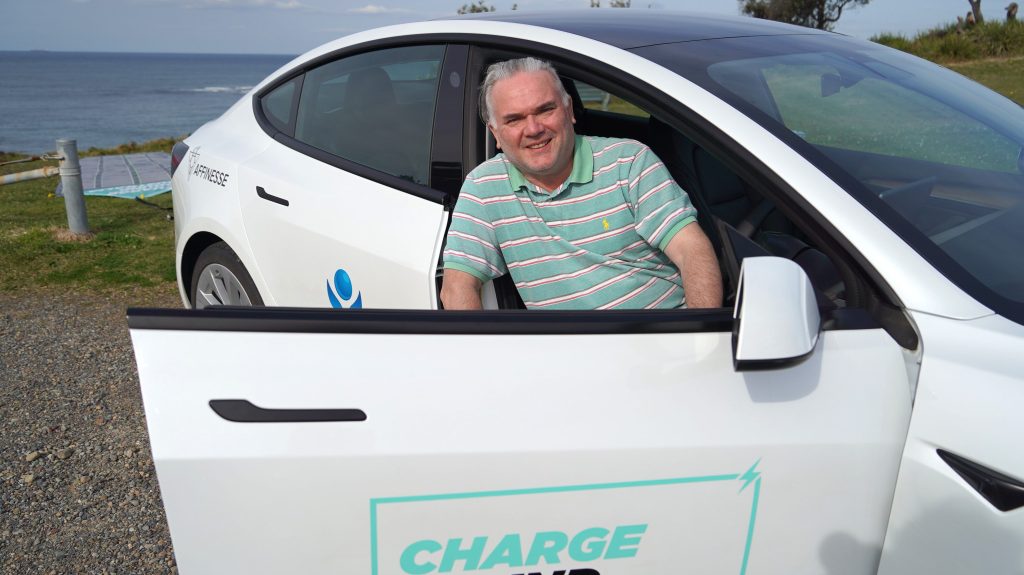
Environmental advocate Stuart McBain finally returned to Newcastle this week after completing an epic 14,500 kilometre road trip around the country in an electric car.
But Mr McBain charged his Tesla in a different way to others, laying 18 printed solar cells in open fields to test whether sunlight could refuel the vehicle and power his journey.
Researchers at the University of Newcastle say the data he collected on his travels could help the inexpensive solar panels to be produced and available within 18 months.
Mr McBain said driving around Australia’s coast in an electric car was not new – “it’s been done 20 times before” – but no one had ever tried to power their electric car with energy collected using printed solar cells.
“The experiment was to see how much (energy) we could harvest under varying conditions, the extremes of weather,” he said.
You might like


“We anticipated that if we had 18 panels rolled out for 10 hours, we’d get 160 km of charge. The project was quite an important milestone in producing printed solar.”
The experiment did hit a hitch, however, when Mr McBain encountered a willy-willy, or a mini-tornado, that destroyed four of the printed panels.
But the sums, he said, did stack up.
University of Newcastle professor Paul Dastoor, who developed printed solar cells, said the experiment provided his team with an “enormous amount of scientific data”, including vital information on how to make the cells tougher.
Stay informed, daily
“Without being brave enough to do these enormously big projects, we simply won’t learn how they’ll work in the real world,” he said.
“What we’ve done is learned about how they work in terms of taking them long distances but also how rugged they are, and how vulnerable they are, for example, to small tornadoes.”
The solar panels are created using a standard “roll-to-roll” printer used to produce newspapers and magazines and proprietary electric inks, Mr Dastoor said.
The panels are then coated with PET plastic and cost less than $10 per square metre to produce.
“We’re already developing plans at the university to build factories to manufacture printed solar,” he said.
“Within 18 months, we anticipate having product ready to go. It’s coming and it’s coming really fast.”
Despite testing the technology to power a vehicle, however, Mr Dastoor said printed solar panels would initially be used to create power solutions for roofs that could not support the weight of traditional solar panels.
The inexpensive solar cells could be used to top up the “tanks” of electric vehicles in future though, he said, particularly in Australia’s sunny climate.
“Most of us only drive 20 km a day in our car and we park it at work and leave it in the sun. You don’t need much energy for it to be useful to charge your car,” he said.
“It could provide your car with energy and it would probably mean you wouldn’t be so fussed about connecting your car to a charger in the car park.”
Want to see more stories from InDaily Qld in your Google search results?
- Click here to set InDaily Qld as a preferred source.
- Tick the box next to "InDaily Qld". That's it.



