Lots in space: Sky is the limit as Aussie tech targets Moon landing
Fleet Space Technologies’ Matt Pearson sets his sights high from his base in Adelaide. The company he cofounded will send their seismic payload to the Moon, making it the first ever Australian tech to touch its surface. And then, there are his flying racing cars…
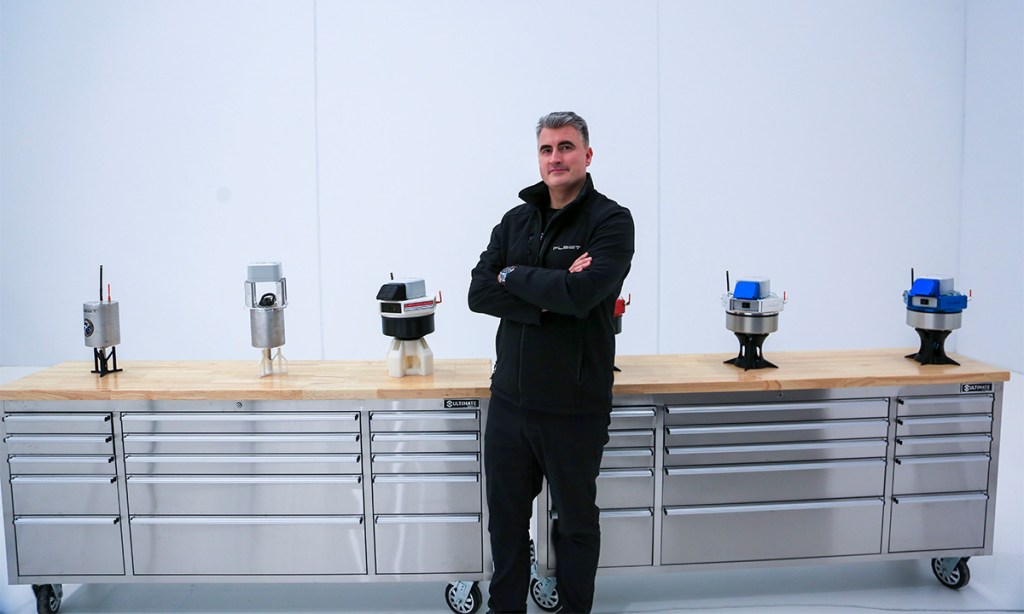
By his own account, Fleet Space Technologies cofounder and chief exploration officer Matt Pearson paid way too much attention to science fiction as a child.
As a young adult following advances in commercial space and rocketry, he was keen to find his entry point.
“These are going to be some of the defining technologies and this huge migration to the Moon and Mars is one of the major stepping stones in kind of the human story,” Pearson said.
“I didn’t want to be on the sidelines, I wanted to be involved and contributing in some small way.”
The serial entrepreneur found his way in when, together with aerospace engineer, Flavia Tata Nardini, he cofounded Fleet Space Technologies in 2015.
The company is a world leader in the development of nanosatellites and their use in cutting edge communications.
Australia’s Defence Space Command is one of their clients, using the tech for remote locations communications.
Fleet also supports mineral explorers searching for the critical minerals to fuel the green energy transition. Their first-of-its-kind system uses their wireless Geodes, nanosatellites and cloud computing to analyse ambient seismic noise and produce a 3D picture of mineral lodes without the need for core drilling core or other destructive techniques.
They have also adapted this technology for space exploration and this is where Pearson gets genuinely excited.
“We’ve been developing our exploration system for many years, with some backing from the Australian Space Agency (ASA) in the hopes that it would be ready to go to the Moon,” he said.
“They’ve been there from the beginning, really believing in us, and it’s been an amazing success story where just a few grant dollars early on have helped us develop a technology that’s been commercially viable and taken off like crazy.”
The seismic sensor will be sent up to the moon in 2025, where it will embed itself in the regolith and listen to the moon’s rumblings.
You might like


“[It will] be the first Australian thing to touch its surface, which is super cool.”
Fleet’s work for ASA, which is also based in Adelaide, will be the first step in Australia’s 7 Sisters mission and align with NASA’s Artemis program. Fleet’s technology will be used to explore for water ice around the Moon’s South Pole.
If easily accessible water resources can be found, it will be a significant milestone in the quest for long-term human habitation on the Moon. Then, said Pearson, “it’s on to Mars”.
Being based in South Australia is strategic, enabling Fleet to tap into the sizable and quality pool of defence engineering talent and access advanced testing facilities.
The state is home to cutting-edge research and development in satellite and space technologies, with more than 100 space companies and the $245 million SmartSat Cooperative Research Centre, as well as the ASA.
Pearson said “Adelaide has been really good” to him and cofounder Tata Nardini.
She migrated to the city about a decade ago, after working as a propulsion engineer at the European Space Agency in The Netherlands. Pearson is a more recent transplant – he moved permanently from Sydney in 2019, also relocating his other company, Alauda Aeronautics. (More on Alauda in a minute.)
“I’ve set up businesses in other states and they’re great places to be, but we didn’t have that same connection as here,” he said.
“You couldn’t easily get to anyone you wanted to talk to, whether in government or corporate.”
Fleet attracted financial backing from Blackbird Ventures, Artesian Venture Partners and Mike Cannon-Brookes’ Grok Ventures, which has helped to rapidly accelerate their technology.
“Venture capital is a special kind of pressure,” Pearson said.
“It really focuses the mind and makes you think, ‘okay, we can’t sit around for too long, we really have to do something that’s world changing and play on global fields immediately’.”
So far, the company has raised over $100 million and has grown from thirty people to one hundred in the past four months. In addition to Adelaide, they have offices in the United States, Canada, South America and Europe.
“We don’t want to add people for the sake of it, but we could be triple that again in a couple of years.”
The advantages of nanosatellites over traditional satellites – and even microsatellites – are many.
A traditional satellite, which is the size of a school bus, can cost up to $500 million to build and needs a similarly pricey rocket for launch into its geostationary orbit thousands of kilometres from Earth.
“You might spend fifteen years developing the technology and then it’s going to be in orbit for twenty years,” Pearson said.
“When you think about how fast technology has changed in the last thirty-five years, very often, by the time you get into space, it’s already obsolete.
Stay informed, daily
“Our nanosatellites are the size of a toaster and we’re able to launch them for less than a million dollars.
“As technology is evolving, we’re able to stay much more current… and then we can do really interesting, specialist things.”
In this era of environmental awareness, there is another benefit. Fleet’s nanosatellites are designed to burn up after a few years in their low Earth orbit 500 kilometres above us and not leave behind “a whole lot of junk”.
“The small satellite revolution is a great opportunity for a nation like Australia.”
“We can be commercially focused, leverage all of the amazing work that’s gone before and also leverage Australia’s technical strengths.
“We’re really good at communications [and] exploration.”
Focusing on doing one thing exceptionally well has benefited Fleet. The number of nanosatellite pioneers globally has whittled down to only a handful as they sought to be all things to all customers.

Pearson has his sights set on another prize too – flying racing cars, which his company Alauda Aeronautics is developing.
“Flying cars and spacecraft are remarkably similar and there’s quite a cross pollination across both companies,” he said.
Races of Alauda’s uncrewed Airspeeder flying cars are already being televised on Fox Sports, as the company gained the lead in the race for the technology thanks to the pandemic.
“That was perfect timing because we were able to continue working here while a lot of our competitors around the world were shut down in lockdowns.
“We were able to build and test our aircraft… and prove that flying car racing is actually a thing. We’ve done that all in South Australia.”
At the moment all the aircraft are Alauda-built because as Pearson said, “we’re the only people in the world mad enough to build flying racing cars”.
“Starting one rung up” the technology ladder with race versions makes for an easier transition to sports and then passenger craft.
Although the widespread use of crewed flying cars “might be twenty years away”, he believes private ownership with flights on private land is likely to begin in the next two or three.
Not unexpectedly, Pearson said leading Fleet and Alauda is fun.
“My favourite thing right now is the spontaneous stuff that I didn’t ask for that the team is coming up with,” he said.
“We all know what ‘the big mission’ is, but there’s a lot of innovation that required all the way through.
“One of our core values is radical ideas, so we really celebrate people who come up with a fantastic new way of doing something, discover a new process or invent something on the way.
“When that starts to spontaneously happen, it’s magical and it feels unstoppable.”
For Pearson, who is aiming for the sky, that is a great way to work and live.
Want to see more stories from InDaily Qld in your Google search results?
- Click here to set InDaily Qld as a preferred source.
- Tick the box next to "InDaily Qld". That's it.
- 7 Sisters,
- A New State of Mind,
- Adelaide,
- Alauda Aeronautics,
- Artemis program,
- Artesian Venture Partners,
- Australian Space Agency,
- Blackbird Ventures,
- careers,
- defence industry,
- Dr Matt Tetlow,
- Flavia Tata Nardini,
- Fleet Space Technologies,
- flying car,
- flying race car,
- Grok Ventures,
- Innovation,
- Matt Pearson,
- nanosatellites,
- NASA,
- SmartSat CRC,
- South Australia,
- Space,
- space exploration,
- Space Industry,
- Sponsored



