If only we could all have a teacher, mentor and friend like the inimitable Mr Banks
A lot of us have been lucky enough to have had one, a teacher who’s shaped our thinking, and opened our eyes to the possibilities of life. Michael Blucher introduces his
The insight is rarely found in the Maths or the English or Chemistry lessons – it’s contained within the teacher’s quite reflection, their encouraging words or their thought provoking questions.
They teach you to count, but more importantly, they teach you what counts. As we grow up, we slide quickly out of their reach into a much wider world, but their words, those little pearls of wisdom, those polite challenges, often linger with us forever.
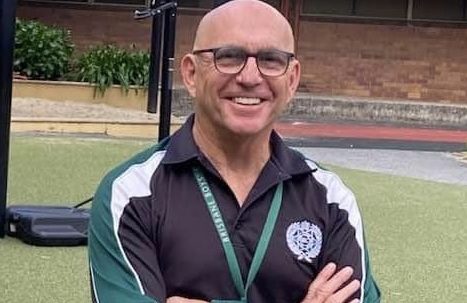
It might seem like a bit of a stretch, but for most of the boys who went through the junior school at BBC over the past 45 years, that “favourite” teacher was the same person. The inimitable Mr Banks.
Since Wayne Banks first walked through the Brisbane Boys College gates in Kensington Tce, in 1980, there’s been 1149 of them – boys in grades four to seven who were placed in his care for a full calendar year.
That he knows that number off the top of his head tells you just how seriously and passionately Banks, now 67, has undertaken his teaching responsibilities, carried out in the same school yards for more than half a lifetime.
He can even tell you the number of boys he really didn’t like. “Four, perhaps five!” he quips, hastening to add, “I didn’t blame the boys – not for a minute. It was their parents who were the problem. The kids were just products of marginal household characteristics!”
Last Friday, the man known simply as “Banksy” strolled out of the junior school class rooms at Toowong for the last time.
He still loves what his does, but as he says, “the hands of father time stop for no-one” – it’s time to hand the “chalk” to somebody a little younger. Somebody a little more modern, somebody who knows how turn on a computer!
In among all those he’s taught, Banks says there are now more than 50
of his past students who have since become fathers themselves, and sent their boys back to BBC.
“I’ve taught fathers and sons, but I’m blowed if I’m going to hang around long enough for some kid to say “Sir, you taught my grandfather!” he laughs. “And I’m probably getting close to that!”
Wayne Banks knew he wanted to be a teacher at the age of 10, a long-sighted adolescent growing in Central Queensland, the eldest of four children crammed into the modest high-set house of John and Joyce Banks.
You might like


John was one of eight, Joyce one of 13, there was little money, but love and kindness oozed from every chamferboard of their home.
At the Allenstown State School in Rockhampton, young Banks remembered every kind and encouraging word his teachers – especially Tom Hogan – ever said to him. They made him feel valued as well as determined – he never wanted to let them down.
That’s what he was going to do when he grew up – help kids learn and grow. And feel valued.
His first teaching gig was in Dalby, on the Darling Downs. Banks went “out bush” not to work, but instead to play rugby. An Australian schoolboy representative in 1975 (after just 10 games in his entire life), Banks had progressed to the Queensland Country team. And there were a couple of young guns in Dalby who he thought would make good teammates.
As fate would have it, the uber-talented McVeigh brothers, Paul and Greg, didn’t play that year. The local club, the Dalby Wheatmen, trained on a Thursday night, which was also when “Dallas” screened on telly. The McVeigh boys were huge Dallas fans. JR Ewing took precedence.
Early on, Banks rocked up at the local Catholic convent school to inquire about a bit of “relief teaching”.
With a sombrero on his head, wearing a sweaty Brothers rugby league jersey and football socks that didn’t match, the 23 year-old might have been mistaken for “key talent” but it was very unlikely. The headmaster David Kerwin was polite enough to thank him for “dropping by”, but that’s where the discussion ceased.
However for reasons unknown, Kerwin quickly had a change of heart, deciding the school could do with an extra pair of hands. He threw the car keys to his wife Maree and asked her to drive around town, in search of a wiry young bloke wearing a sombrero and a blue and white footy jersey.
Banks was finally located, pushing a lawn mower in the Myall St front yard of Bruce Kennon, another Queensland rugby player. St Columbas School had a new staffer. “At least he’s upright and breathing”, Kerwin was reported to have said at the time.
Ironically, it was the Kerwin’s profoundly deaf son, James, who gave “Mr Bang” his first valuable insight into teaching. The young boy struggled with the “NG” sound, on account of his severe hearing impairment, but he was incredibly insightful, attuned to the tiniest of facial expressions.
“Why does the sister say she loves us when her face says she doesn’t?” James asked, after a religious lesson from the local convent. The small boy’s observation immediately alerted the rookie teacher to the importance of sincerity and authenticity, in everything you do and say. Mr “Bang” took heed, and carried both qualities tenderly through the entirety of his teaching career.
At the end of that year, there was an ad in the local newspaper for a teaching job at Brisbane Boys College in Brisbane. It was the perfect opportunity to get back to Brisbane, where he could also pursue his rugby career. He had a few mates who played down at the Wests Bulldogs, among them a crotchety old prop by the name of Stan Pilecki, who had played a couple of seasons with Banks at the Pioneers club in Rocky.
As soon as was appointed to BBC by Graham Thomson, the school’s long serving, highly regarded headmaster, Banks joined the “The Kennel”. The Bulldogs club ground in Toowong was only a couple of spiral punt kicks away from his new place of employment.
Banks loved the idea of working in the junior school. In the more senior grades, teachers only saw students for an hour at a time, three or four times a week.
In the junior school, they were with the kids all the time, affording the opportunity to really get to know the students. To use a building analogy – you could slap of bit of paint on the walls, or you could get into the woodwork, build strong foundations. He knew where the true value lay.
Settling into BBC, Banks quickly found a mentor of his own, a wonderfully sage junior school teacher by the name of Rob Park. Park and his wife, Jenny were parents to five adopted children of different nationality, before they took in a sixth, a young girl with Down syndrome.
Stay informed, daily
“Their family was a league of nations – it’s hard to imagine a more caring, giving couple – they were simply extraordinary,” Banks explained.
Rob Park quickly reaffirmed what Wayne Banks suspected from his earliest days of teaching – no two 11-year-old boys were the same. If there were 30 kids in a class, there were probably close to 30 different personalities, all requiring at least a slightly different approach.
Wayne Banks made flexibility his trademark.
“If a kid wants to sit in class all day with a box on his head, that’s fine by me,” he says. “It’s not like he’s hurting anybody. They all express themselves in different ways. What remains constant is their need to feel safe, valued and supported. Surround them with good people, and they’re well on the way to becoming strong contributors to society.“
Just as important, a teacher giving something of themselves. The kids knew that Mr Banks was a huge Cowboys fan, that he was married to Libby, “his rock” (and also an outstanding educator) that he wrote songs and poetry – not very well – and that he hated cucumber. His life was an open book.
“At one level, you might be a figure of authority, but more importantly, you’re a human being – just a much, much older one who’s been around the block a million times,” he laughs.
In amongst the brain food that Banks serves up, there are a couple of staples that encapsulates his outlook on life. As important as any – “look up and out, not down”.
It was something that dawned on him in 2012, during a three month sabbatical teaching in London. Every day walking from Clapham North tube station to the school, he would pass a man sitting in his front bay window. The man would routinely smile and wave.
In the final week of his time in London, Banks knocked on the front door, introduced himself, and thanked the stranger for making him feel so welcome. Soon after, the gentleman would have a poem written in his honour. “A man in the window”.
Look up and out, and you see so much more. You see beautiful scenery, smiling faces, magnificent buildings, opportunities. Possibly even your life partner, standing right in front of you.
Look down, and the risk is you miss it all.
“It’s one of the main reasons why we need to get mobile phones and social media out of the lives of young people,” he says. “Kids everywhere are spending more and more time looking down, staring at a screen. They need to be looking up, otherwise life will pass them by.”
Over the course of his 45 years at BBC, Banks received thousands of keep sakes and cards and letters from students and parents, each and every one of them special in some small way.
Sadly, due to their new “apartment lifestyle”, wife Libby is not allowing her husband to bring all his “goods and chattels” home. He’s been forced to “recycle” everything, except one special gift that evokes a small but important sense of pride.

A garden gnome, with a little sign around its neck. “Anyone can teach, but only a few can reach”.
Wayne Banks reached thousands – once small wide-eyed youngsters who in the fullness of time, have gone on to become Rhodes scholars, captains of industry, business leaders, carpenters, musicians, stock brokers, plumbers, even Wallaby skippers, their life journey made just that little bit easier by being given a gentle push in the right direction by a good man who genuinely cared.
Enjoy your retirement, Mr Banks.
And thanks for returning the blow dart gun that our errant son gave you as a Christmas present at the end of Grade 5. We’ve been absolutely lost without it.
Want to see more stories from InDaily Qld in your Google search results?
- Click here to set InDaily Qld as a preferred source.
- Tick the box next to "InDaily Qld". That's it.



