Las Vegas bids farewell to its final gangland links as Tropicana bites the dust
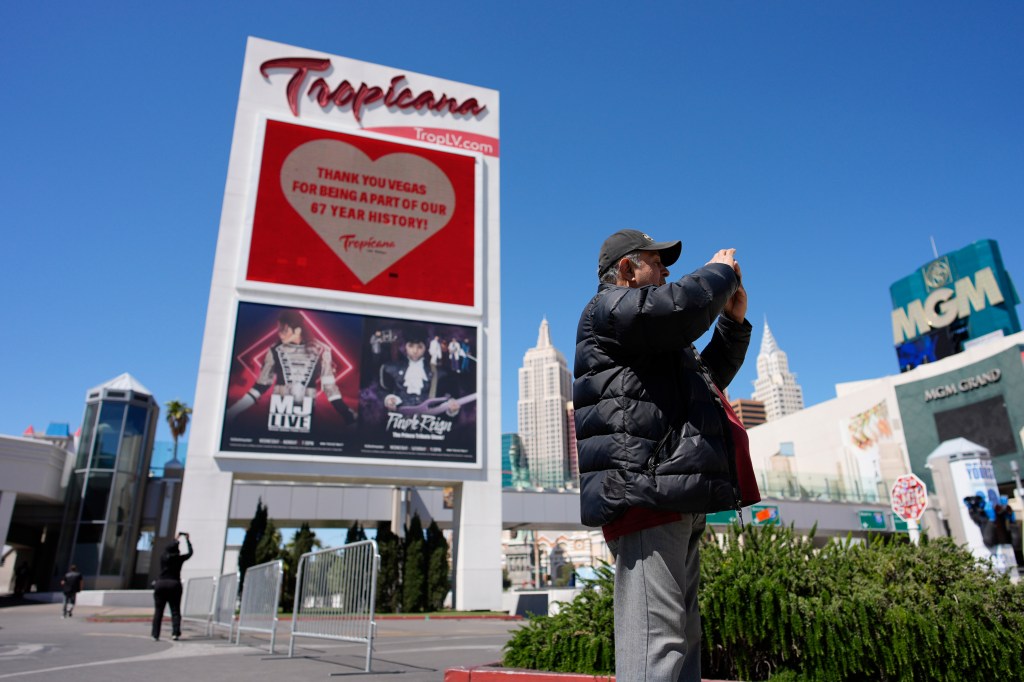
Sin City has blown a kiss goodbye to the Tropicana before first light in an elaborate implosion that reduced to rubble the last true mob building on the Las Vegas Strip.
The Tropicana’s hotel towers tumbled on Wednesday in a celebration that included a fireworks display.
It was the first implosion in nearly a decade for a city that loves fresh starts and that has made casino implosions as much a part of its identity as gambling itself.
“What Las Vegas has done, in classic Las Vegas style, they’ve turned many of these implosions into spectacles,” said Geoff Schumacher, historian and vice president of exhibits and programs at the Mob Museum.
Former casino mogul Steve Wynn changed the way Las Vegas blows up casinos in 1993 with the implosion of the Dunes to make room for the Bellagio.
Wynn thought not only to televise the event but created a fantastical story for the implosion that made it look like pirate ships at his other casino across the street were firing at the Dunes.
You might like


From then on, Schumacher said, there was a sense in Las Vegas that destruction at that magnitude was worth witnessing.
The city hasn’t blown up a Strip casino since 2016, when the final tower of the Riviera was levelled for a convention centre expansion.
This time, the implosion cleared land for a $US1.5 billion ($A2.2 billion) baseball stadium for the relocating Oakland Athletics, part of the city’s latest rebrand into a sports hub.
That will leave only the Flamingo from the city’s mob era on the Strip.
But, Schumacher said, the Flamingo’s original structures are long gone. The casino was completely rebuilt in the 1990s.
The Tropicana, the third-oldest casino on the Strip, closed in April after welcoming guests for 67 years.
Stay informed, daily
Once known as the “Tiffany of the Strip” for its opulence, it was a frequent haunt of the legendary Rat Pack, while its past under the mob has long cemented its place in Las Vegas lore.
It opened in 1957 with three stories and 300 hotel rooms split into two wings.
As Las Vegas rapidly evolved in the following decades, including a building boom of Strip mega resorts in the 1990s, the Tropicana also underwent major changes.
Two hotel towers were added in later years. In 1979, the casino’s beloved $US1 million ($A1.5 million) green-and-amber stained glass ceiling was installed above the casino floor.
The Tropicana’s original low-rise hotel wings survived the many renovations, however, making it the last true mob structure on the Strip.
Behind the scenes of the casino’s grand opening, the Tropicana had ties to organized crime, largely through reputed mobster Frank Costello.
Costello was shot in the head in New York weeks after the Tropicana’s debut.
He survived, but the investigation led police to a piece of paper in his coat pocket with the Tropicana’s exact earnings figure, revealing the mob’s stake in the casino.
By the 1970s, federal authorities investigating mobsters in Kansas City charged more than a dozen operatives with conspiring to skim $US2 million ($A3 million) in gambling revenue from Las Vegas casinos, including the Tropicana.
Charges connected to the Tropicana alone resulted in five convictions.
Want to see more stories from InDaily Qld in your Google search results?
- Click here to set InDaily Qld as a preferred source.
- Tick the box next to "InDaily Qld". That's it.



